SEO, GEO, SEA. If you're not familiar with digital marketing, these three acronyms get confusing fast.
So let's simplify what each one means, explain how they complement each other, and above all show what changed in 2026 with the arrival of advertising inside AI engines.
Quick answer
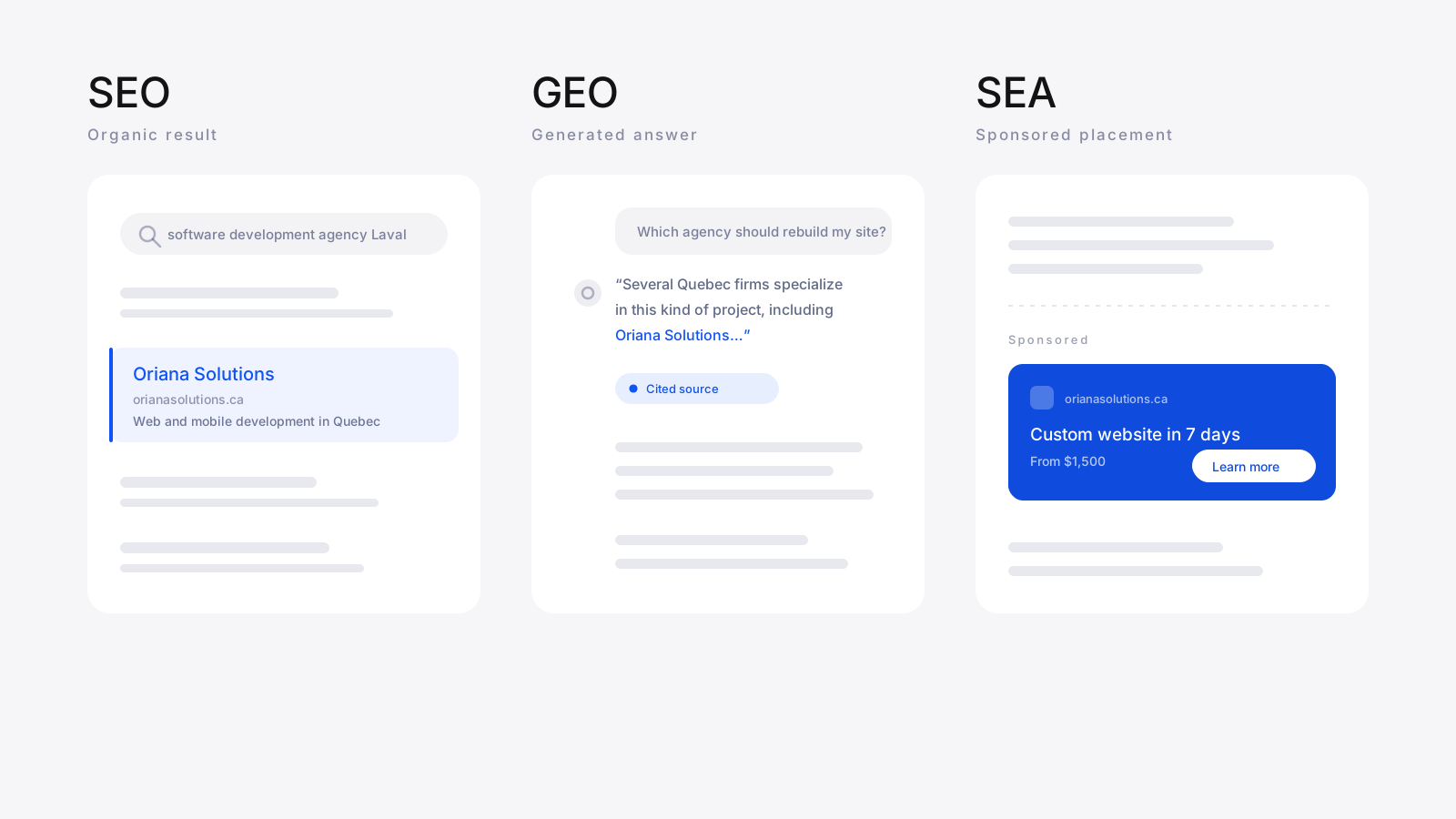
SEO improves your place in Google results, SEA puts you there through paid advertising, and GEO helps you get cited by ChatGPT, Gemini, Perplexity and Claude. You'll also see the acronyms AEO, AI SEO and LLMO: for the most part, they are other names for the same work as GEO. For an SME, start with SEO and the technical basics, add GEO to get cited by AI, and use SEA for fast results.
Summary: the answers in 30 seconds
- ✓What is SEO? Organic search optimization: improving your position in Google without paying for each click.
- ✓What is GEO? Optimizing your presence to be mentioned or recommended by AI search engines and assistants.
- ✓What is SEA? Paid advertising in search engines, and now in ChatGPT.
- ✓What are AEO, AI SEO and LLMO? Terms close to GEO. AEO aims to become the direct answer, AI SEO means two different things (see below) and LLMO targets large language models.
- ✓Should you pick just one channel? No. SEO is the foundation of GEO, and SEA delivers results while the other two build up.
- ✓Where to start? With the technical basics (robots.txt, server rendering), then content, then advertising if you want fast results.
1. Search Engine Optimization (SEO)
This is easily the best-known acronym.
SEO, or Search Engine Optimization, covers every strategy aimed at improving your organic ranking in search engines like Google.
There are many SEO strategies, including:
- ✓Content and blog creation
- ✓Technical optimization of a website
- ✓Page and keyword optimization
- ✓Backlink building
- ✓Local search optimization
- ✓Improving structure and user experience
The goal is simple: increase your chances of showing up in search results when potential clients look for your products or services.
SEO remains the most cost-effective medium-term channel for a Quebec small business. A site ranking well for "accountant Laval" or "employment lawyer Montreal" brings in qualified clients every month without paying per click. That's the subject of our SEO agency in Montreal page.
2. Generative Engine Optimization (GEO)
GEO, or Generative Engine Optimization, borrows some SEO principles but aims to improve your visibility inside AI-powered engines and tools such as ChatGPT, Gemini, Perplexity or Claude.
For instance, someone might ask ChatGPT:
What are the best software development agencies in Longueuil?
A typical search
asked to an artificial intelligence tool
This shift in habits isn't marginal. Radio-Canada reported as early as February 2023 that ChatGPT had reached 100 million monthly active users two months after opening to the public, which analysis firm UBS called the fastest ramp-up ever observed for a consumer web application. TikTok took nine months, Instagram two and a half years. Three years later, the platform has roughly a billion users.
Some of your clients are already looking for suppliers through this channel, and those searches appear nowhere in your Google Analytics reports.
How we actually work on GEO
This is where most articles stay vague. Here are the six things we genuinely put in place.
We open the door to agents
The robots.txt file must explicitly allow GPTBot, PerplexityBot, ClaudeBot and Google-Extended. Many sites block them without knowing it, through a default setting from their host or firewall. It's the first thing to check, and often the most profitable.
We make content readable without JavaScript
Pages must be server-rendered. An agent that doesn't run JavaScript has to see exactly the same text a human does. That's the difference between being read and being ignored.
We declare information as structured data
Schema.org on the organization, services, prices, reviews, hours and FAQ. The agent no longer has to guess what you sell or what it costs: it's written in a format it reads without ambiguity.
We expose actions, not just pages
That's what WebMCP is for: describing what an agent can do on your site, request a quote, book a time slot, check availability, as callable actions rather than forms it has to figure out. The field is moving fast and Google's documentation still describes it as under development, but sites preparing for it today will be ahead.
We write quotable answers
Every important question gets a direct answer in the first sentence of its section, with numbers and a source. An agent cites what it can lift in one block, not what it has to reassemble across three paragraphs.
The FAQ at the bottom of this article is an example of that format.
We verify with the agents themselves
We ask ChatGPT, Perplexity and Copilot the questions your clients actually ask, then check whether you come up, how you're described and what's inaccurate. We rerun this test every month. The full method is on our GEO optimization page.
AEO, AI SEO, LLMO: what do all these terms mean?
The vocabulary changes fast, and several acronyms describe practices that largely overlap. Here's how to tell them apart.
In our reading, GEO is the most widely used term for optimizing for AI engines, and the others are variants that stress a different angle. In practice, the work looks very similar: a site that robots can read, content that answers questions directly and a solid reputation on the web.
| Term | Meaning | What it emphasizes |
|---|---|---|
| SEO | Search Engine Optimization | Showing up in traditional search results, like Google. |
| GEO | Generative Engine Optimization | Being mentioned or recommended in generative AI engine answers. |
| AEO | Answer Engine Optimization | Becoming the direct answer to a question: featured snippets, voice assistants, AI overviews and chatbots. |
| AI SEO | Two possible meanings | Either using AI to do SEO (writing, analysis), or doing SEO to be visible in AI tools. Check the meaning before comparing offers. |
| LLMO or LLM SEO | Large Language Model Optimization | Being well represented in large language models like ChatGPT, Claude and Gemini. |
| GSO | Generative Search Optimization | A GEO variant, sometimes used as a synonym. |
These definitions reflect common industry usage, which isn't standardized. The same words can mean slightly different things depending on the agency or tool.
What's the difference between GEO and AEO?
AEO (Answer Engine Optimization) thinks in answers: someone asks a question, and you want your block of text to be the one that answers. The idea predates ChatGPT, with Google's featured snippets and voice assistants. GEO widens the view: besides answering, it's about being cited, recommended and described correctly by engines that synthesize several sources. A good answer page serves both.
AI SEO: using AI for SEO, or doing SEO for AI?
This is the most ambiguous term. Some use it for AI tools that speed up SEO: keyword research, first drafts, page analysis. Others use it as a synonym for GEO. When an agency offers "AI SEO", ask which of the two it's selling: one is a way of working, the other is a result (being visible in AI). At Oriana, we do both, but it's the second one we bill for.
3. Search Engine Advertising (SEA)
Finally, SEA, or Search Engine Advertising, is paid advertising inside search engines.
In practice, you pay for your business to appear among the top sponsored results when a user searches. That's the domain of Google Ads.
Unlike SEO and GEO, SEA can have an almost immediate impact. However, the moment you stop paying, your paid visibility disappears. SEA serves short and medium-term results, while SEO and GEO are long-term strategies.
What changed in 2026: SEA moves into AI
Until now, those three acronyms were enough. That's no longer true.
According to Agence France-Presse, as reported by La Presse, OpenAI began testing advertising in ChatGPT on February 9, 2026, with adult users on free plans in the United States, expanding gradually by country. The ad appears below the answer, clearly labelled as sponsored, and doesn't influence the content of the answer itself.
In other words, paid placements now exist inside AI engines too. So you need to think in four boxes rather than three rows.
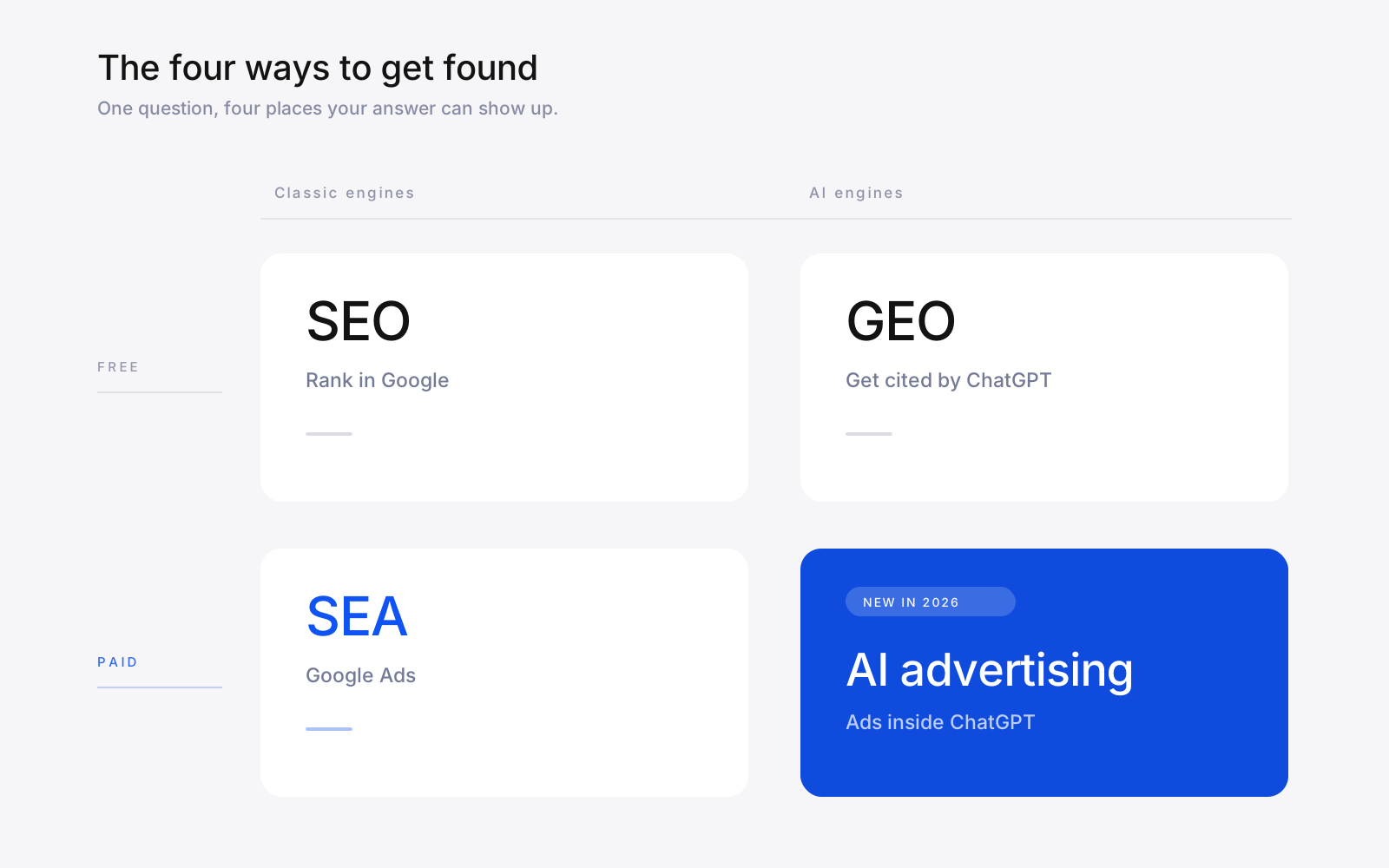
The most disorienting difference for someone coming from Google is that inside ChatGPT you don't buy keywords. You describe the situations where your offer is relevant, and the system decides placement from the conversation's context. The person has often already explained their budget and constraints before your ad shows up.
We cover the format, targeting and costs in detail on our ChatGPT advertising page.
SEO, GEO or SEA?
In short:
| Strategy | What it aims for | Horizon |
|---|---|---|
| SEO | Ranking higher in search engines | Long term |
| GEO | Being cited and recommended by generative AI engines | Long term |
| SEA | Paying to appear in Google's sponsored results | Short and medium term |
| AI advertising | Paying for a placement under ChatGPT's answers | Short and medium term |
SEO and GEO take time to pay off: the first effects show after a few weeks, and ranking on competitive queries generally takes 3 to 6 months. In exchange, a solid foundation keeps producing results long after the initial work.
Where should you start, depending on your situation?
- ✓Your site is new or rarely updated: start with the technical basics (robots.txt, server-side rendering, structured data), then one page per service.
- ✓Your site is solid but not very visible: work on content and your customers' questions (SEO and GEO together), and collect Google reviews.
- ✓You want leads quickly: run a SEA campaign in parallel while SEO and GEO build up.
- ✓You already rank well on Google: test your presence in ChatGPT, Perplexity and Gemini. That's where the gap widens.
SEO remains the foundation: according to an analysis presented in our GEO training, 38% of citations in Google's AI Overviews come from Google's top 10 results. To go further, our free GEO training for SMEs, nonprofits and incubators summarizes the three pillars (content, authority, technical).
How to measure where you stand
Most articles stop at SEO tools. Those measure only one of the four boxes.
For SEO and SEA
Semrush to analyze your ranking and your competitors'. Ahrefs for backlinks and keywords. Google PageSpeed Insights for your site's technical performance. Google Search Console, free, to see the queries already bringing you traffic.
For GEO and AI advertising
There's no Search Console equivalent for AI engines yet. The method is still manual, which is exactly why so few businesses do it.
List the ten questions your clients ask before buying. Ask them verbatim to ChatGPT, Perplexity, Copilot and Gemini, in a window with no conversation history. Note whether you appear, which competitors are cited, and what information about you is wrong or outdated. Repeat monthly, always with the same questions, so you can compare.
Also check your robots.txt: if it blocks GPTBot, no amount of optimization will help.
What about Oriana Solutions?
At Oriana Solutions, we're among the first software development agencies in Quebec to offer a service combining SEO, GEO, Google advertising and advertising inside AI engines.
This approach is part of our digital visibility offering, built so a business gets discovered on traditional engines as much as in the new search environments.
Our offering starts at $250 for the audit and analysis of your visibility, $750 to roll out the action plan, then $250 per month for ongoing optimization. That monthly amount covers our fees; the ad budget paid to Google or OpenAI is separate and set with you.
To see how we apply these three levers, check out our SEO agency in Montreal and our GEO optimization service.
Go further
Frequently asked questions
Do you have to choose between SEO, GEO and SEA?
No. They answer different needs over different timeframes. SEA delivers immediate results but stops with the budget. SEO and GEO take months but keep producing afterwards. In practice, a business starting out often uses SEA to generate volume while SEO and GEO are being built.
Does GEO replace SEO?
No, it builds on it. AI engines largely feed on the same signals as Google: quality content, clean technical structure, domain authority. A site with poor SEO will have poor GEO. GEO adds a layer on top: explicitly allowing AI crawlers, complete structured data, directly quotable answers.
How long before results show?
Technical fixes take effect within weeks: speed, indexing, structured data, Google Business profile. Ranking on competitive keywords generally takes 3 to 6 months. Nobody can honestly promise first position in thirty days.
Can you really get recommended by ChatGPT?
Yes, but not by buying the answer. Free citations and paid placements are two separate systems at OpenAI: advertising doesn't influence the content of answers. Being cited depends on how readable your site is to an agent, how clear your structured data is, and how precise your answers are.
Is ChatGPT advertising available in Quebec?
Testing began on February 9, 2026 in the United States and availability is opening gradually by country. We check weekly. What's possible right now is preparing the account, strategy, creatives and context signals, so you can run from day one instead of starting to read the documentation then.
What does a click inside ChatGPT cost?
OpenAI recommends starting with a bid between US$3 and US$5 per click. Bidding is second-price and weighted by relevance: the fewer advertisers in your niche, the lower the winning bid. That's a level that won't last, as on every ad network at launch.
What is AEO?
AEO (Answer Engine Optimization) means optimizing your content to be the direct answer to a question, in Google's featured snippets, voice assistants, AI overviews and chatbots. It's a close cousin of GEO.
What is AI SEO?
The term has two meanings. It refers either to using AI tools to do SEO faster, or to SEO aimed at making your business visible in AI tools, which amounts to GEO. Always clarify the meaning with the agency.
What's the difference between GEO, AEO and LLMO?
GEO aims to get cited by generative AI engines, AEO to become the direct answer to a question, and LLMO to be well represented in large language models. The three overlap and rest on the same basics: a site robots can read, content that answers questions and a good online reputation.
Does GEO replace SEO?
No. To recommend you, an AI must first discover, read and evaluate your site, and good SEO practices help at each of these steps. SEO is the foundation of GEO.
Sources
Radio-Canada. February 2, 2023. "ChatGPT sets the record for the fastest-growing user base": the 100-million-user mark, UBS study citing Similarweb, comparison with TikTok and Instagram. Read
La Presse, Agence France-Presse. February 10, 2026. "OpenAI has begun testing advertising in ChatGPT": launch date, plans targeted, user numbers. Read
OpenAI. Advertiser documentation: ad format, selection, pricing and measurement. Read
Google. Documentation on agentic browsing and WebMCP integrations.
Information verified on August 19, 2026. This field moves quickly: confirm with the source before any budget decision.
Key takeaway
The goal isn't only to build your online presence, but to make sure your clients can actually find you, wherever they're looking. In 2026, that means four places, not one.
Shall we see where you stand?
The visibility audit starts at $250 and you leave with a clear picture of your online presence and the opportunities to seize, whether or not you hand us the next step.