
Generative Engine Optimization (GEO): make sure AI recommends you.
GEO optimizes your site to be understood, cited, and recommended by ChatGPT, Copilot, Perplexity, and Gemini, in addition to Google.
Why it matters
Why does GEO matter for you?
The number of people asking an AI their questions instead of Google grows every month. The earlier you're present there, the faster you become the reference the AI recommends.
What is GEO
SEO pushes your site up Google. Generative Engine Optimization (GEO) gets AI to recommend you.
Gartner predicts search volume on traditional engines will drop 25% by 2026, replaced by AI chatbots and virtual agents. Your potential customers increasingly use ChatGPT, Perplexity, Copilot, and Gemini to find a trustworthy business, compare their options, and get a provider recommended to them, often before even opening Google.
One of our own prospects, Grégoire, confirmed it: when we asked how he'd heard of Oriana Solutions, he told us an AI tool had referred us. Generative engine optimization isn't a technical curiosity anymore, it's a real acquisition channel.
What we optimize for AI
We markup your services, reviews, and business so AI agents understand exactly who you are and what you offer.
We structure your pages with clear, direct answers, the format AI agents prefer to cite in their responses.
We make your site easier for autonomous AI agents to navigate, a field still under development that we already master.
We strengthen the expertise, experience, and trustworthiness signals AI models use to decide who to recommend.
Google reviews, directories, professional networks: we optimize the sources AI tools consult to shape their answers.
llms.txt files and technical setup so major AI platforms' crawlers can read your site correctly.
We monitor how and when your business is mentioned in ChatGPT, Perplexity, and Copilot's answers.
GEO Autopilot
We execute, you measure.
We don't hand you an audit to execute. We run the optimizations for you and measure how your visibility evolves inside AI engines.
The good news : SEO is the foundation of GEO. The work we do to improve your Google ranking also strengthens your presence in AI engines. One stone, two birds.
All four pillars are included. We reprioritize them each month based on what AI engines actually return about your business.

“Since we optimized our own site for GEO, several clients have told us they were referred by ChatGPT. That's now close to 25% of our inbound leads.”
A site ready to be cited
- Optimize service pages for indexing by AI crawlers
- Build the pages you're missing
- Add FAQs answering real customer questions
- Add Schema.org structured data
- Clarify your services, sectors and service areas
- Optimize internal semantic linking and the site's accessibility tree
Authority that keeps building
- Identify high domain rating (DR) sources used by AI engines
- Get your business listed in the relevant directories
- Earn mentions on specialized sites
- Run public relations campaigns
- Build backlinks with strong domain authority
- Create partnerships with sites and organizations
- Optimize your existing business profiles
Content that gets noticed
- Map conversational queries and search intent
- Write articles that answer those questions
- Produce guides and comparisons
- Build targeted service pages
- Publish content on a regular cadence
- Refresh existing content to maintain its freshness signal
Visibility that keeps growing
- Regularly test your key queries across AI engines
- Measure how often your business gets recommended
- Track citation rate (share of voice) across AI engines
- Benchmark your results against competitors
- Spot new opportunities as they appear
- Receive a monthly report: what we did, the results, what's next
The gap is widening
Your clients are already asking an AI for advice.
The question isn't whether your clients will use AI to shop, it's whether you'll be in the answer.
We apply what we recommend, ourselves.
Most agencies talk about GEO without any concrete proof. We build our own sites with the structured data, markup, and architecture we recommend to our clients: our own website already applies agentic navigation best practices. An agency that builds its own tools understands GEO from the inside, not just in theory.
Agentic navigation
How we make agentic navigation easier.
An AI agent visiting your site doesn't read it the way a human does. It doesn't wait for an animation to finish, doesn't open a dropdown menu, and doesn't decipher a price baked into an image. It reads text, markup and declared actions. Here's what we put in place, concretely.
- 01
We open the door to agents
The robots.txt file explicitly allows GPTBot, PerplexityBot, ClaudeBot and Google-Extended. Many sites block them without knowing it, through a default setting from their host or firewall. It's the first thing we check.
- 02
We make content readable without JavaScript
Pages are server-rendered. An agent that doesn't run JavaScript sees exactly the same text you do. That's the difference between being read and being ignored.
- 03
We declare your information as structured data
Schema.org on the organization, services, prices, reviews, hours and FAQ. The agent no longer has to guess what you sell or what it costs: it's written in a format it reads without ambiguity.
- 04
We expose your actions, not just your pages
That's what WebMCP is for: describing what an agent can do on your site, request a quote, book a time slot, check availability, as callable actions rather than forms it has to figure out.
- 05
We write quotable answers
Every important question gets a direct answer in the first sentence of its section, with numbers and a source. An agent cites what it can lift in one block, not what it has to reassemble across three paragraphs.
- 06
We verify with the agents themselves
We ask ChatGPT, Perplexity and Copilot the questions your clients actually ask, then check whether you come up, how you're described and what's inaccurate. We rerun this test every month.
“These checks ensure high-quality, AI agent-crawlable websites, and validate the accuracy of WebMCP integrations. This category is still under development and subject to change.”
Google documentation on agentic navigation
It's a fast-evolving field. We make sure your site already applies these best practices, while most of your competitors haven't thought about it yet.
What we add to GEO
GEO no longer stops at free content.
Since February 2026, ChatGPT shows sponsored placements under its answers. Being cited for free and buying a placement are now two levers on the same problem: owning the answer when your client asks the question. We're among the first agencies in Quebec to prepare and run these campaigns, and it's a full part of our GEO approach.
See how we run advertising inside ChatGPTWhy work with us?
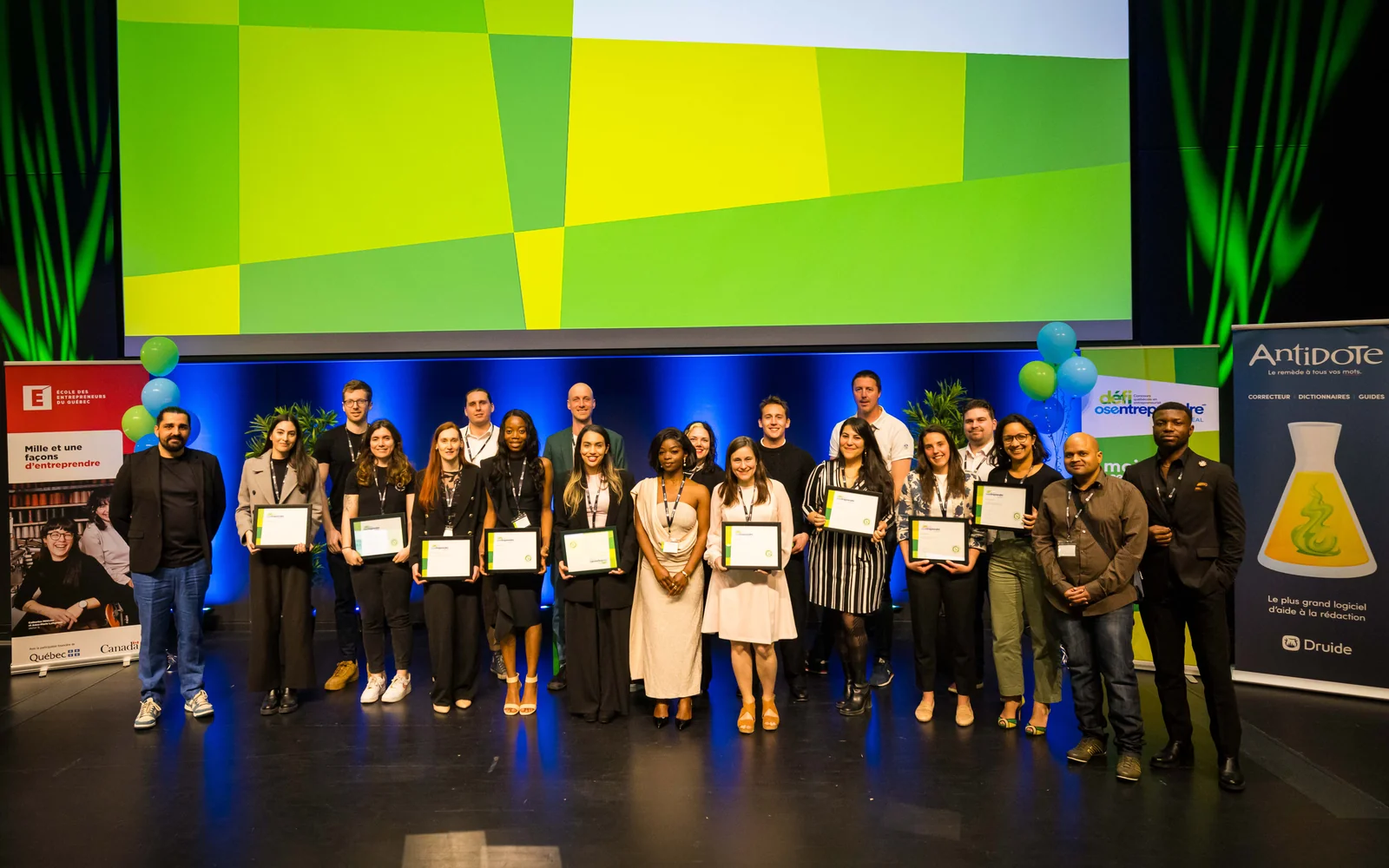
In 2025, our team won first place nationally at the OSEntreprendre challenge, the largest entrepreneurship competition in Québec. We designed and delivered a mobile application from scratch, up against the best teams in the province. If we can win at a national scale, we can deliver your project.
Frequently asked questions
Generative Engine Optimization (GEO) is the optimization of your digital presence to be understood, cited, and recommended by generative AI agents like ChatGPT, Copilot, Perplexity, and Gemini, rather than only by traditional search engines.
We track your brand's mentions in the answers of major AI tools, your pages' presence among cited sources, and traffic evolution coming from these platforms. It's still a young field where measurement tools are evolving quickly.
No, it complements it. AI engines still rely heavily on the same signals as SEO (quality content, authority, technical structure). A site well optimized for SEO already has a head start on GEO.
GEO has the most impact for service businesses where customers actively search for a trusted provider before buying: appraisers, health professionals, brokers, accountants, and several similar industries.
Generally on a similar timeline to SEO, about 3 to 6 months for solid gains. Precise tracking is still evolving, but the foundations we put in place (structured data, clear content, authority) also benefit traditional search rankings.
Because GEO is built, not switched on. The structured data, content and authority we develop need that time to be discovered, indexed, and then cited by AI engines. A shorter commitment wouldn't give the optimizations time to produce a measurable effect, and we don't charge for work whose results we can't yet show.
Related services
Let's talk about your project
Tell us what you have in mind, even roughly. We come back quickly with a first read and a price range.

Bring your digital ambitions to life.
We build intuitive software solutions and prestigious showcase websites that reflect the excellence of your organization.
Your website in 7 days, your MVP in 14 days
Fixed price, all included. Only 3 new projects accepted per month.