GEO (generative engine optimization) is the set of practices that optimize a website to be understood, cited, and recommended by generative answer engines like ChatGPT, Perplexity, Copilot, and Gemini — the equivalent of SEO, but for AI rather than for Google.
If you're reading this, it's probably because your customers have started asking an AI for advice before ever contacting you. That's not an isolated anecdote: it's a real shift in behaviour, and it's accelerating faster than most businesses are prepared for.
The rest of this article explains what that actually changes, and where to start.

GEO and SEO: two complementary disciplines
SEO (search engine optimization) aims to push a page up Google's results: keywords, links, technical structure, content that answers a specific search intent. It's a discipline we've mastered for years, and it remains essential.
GEO aims at something different: being understood and cited by an AI that writes a complete answer on the user's behalf, often without a single click to a website. The battle isn't just for the first position anymore, it's for being one of the sources the AI chooses to cite, or summarize.
For example, if a customer types 'which agency can build custom software in Quebec for under $25,000' into ChatGPT, the AI doesn't return ten blue links. It writes an answer and cites two or three sources it judges most reliable. If your site isn't one of them, you simply don't exist in that answer.
It's not a replacement, it's an extension. A site with solid SEO foundations (quality content, clear structure, recognized authority) already has a head start on GEO, because generative engines rely heavily on the same signals as Google. An SEO agency in Montreal that already masters traditional search can extend that work to GEO without starting from scratch.
How generative engines choose their sources
A generative AI doesn't browse a site the way a human clicking from page to page would. It queries an index, evaluates several sources in parallel, then writes an answer citing whichever ones respond most clearly and most directly to the question asked.
Four factors come up constantly in how it chooses what to cite:
- ✓Structured content: direct answers near the top of the page, clear headings, lists and tables instead of long dense paragraphs.
- ✓Factual consistency: the same information (pricing, timelines, contact details) repeated identically across your site, directories, and social profiles.
- ✓Structured data (schema.org): markup that explicitly states what a page, a service, or a question-and-answer is, so the AI doesn't have to guess.
- ✓Easy access (llms.txt): a file that tells AI crawlers what they can read and where to find the essentials of your site.
A site that checks all four boxes doesn't need massive traffic to get cited. It just needs to be clearer than the other sources the AI found.
Why it matters, even for a small business
You'd think only large brands need to worry about GEO. It's actually the opposite. A large company already has brand recognition protecting it: it gets cited out of habit, because its name comes up everywhere anyway.
An SME is still building that place for itself. And that's exactly where GEO becomes an interesting shortcut: a well-structured site, with clear answers and consistent data, can get cited by an AI right alongside a competitor ten times its size, simply because its content is easier to understand and verify.
It's one of the rare arenas where company size matters less than the clarity of your content.
Concrete steps for a Québec SME
You don't need to redo everything at once. The first step is usually figuring out where you actually stand: a free audit shows what an AI already says about your business today, before you change anything. From there, here's where to continue, in order:
- ✓Ask ChatGPT or Perplexity directly what they know about your business. It's the most honest starting point.
- ✓Restructure your service pages with a clear answer in the first few lines, not buried only in an FAQ.
- ✓Add schema.org markup to your services, your business, and your frequently asked questions.
- ✓Check that your pricing, timelines, and contact details are identical everywhere your business appears online.
- ✓Publish an llms.txt file and confirm nothing technically blocks AI crawlers from reading your site.
Different traffic, but engaged
Visitors who arrive from an AI assistant have usually already done part of the thinking: the AI summarized their options before the first click. We find this type of visitor ranks among the most engaged on the site. None of these steps require a large-company budget. That's exactly what makes GEO accessible to an SME that has never had a marketing department.
AEO, AI SEO, LLMO: what do all these terms mean?
The vocabulary changes fast, and several acronyms describe practices that largely overlap. In our reading, GEO is the most widespread term, and the others are variants stressing a different angle.
| Term | Meaning | What it emphasizes |
|---|---|---|
| GEO | Generative Engine Optimization | Being mentioned or recommended in generative AI engine answers. |
| AEO | Answer Engine Optimization | Becoming the direct answer to a question: featured snippets, voice assistants, AI overviews and chatbots. |
| AI SEO | Two possible meanings | Either using AI to do SEO, or doing SEO to be visible in AI tools. Check the meaning before comparing offers. |
| LLMO or LLM SEO | Large Language Model Optimization | Being well represented in large language models like ChatGPT, Claude and Gemini. |
| GSO | Generative Search Optimization | A GEO variant, sometimes used as a synonym. |
These definitions reflect common industry usage, which isn't standardized. See also our article [SEO, GEO and SEA](/blogue/seo-geo-sea-quelle-strategie-choisir).
GEO isn't a passing trend
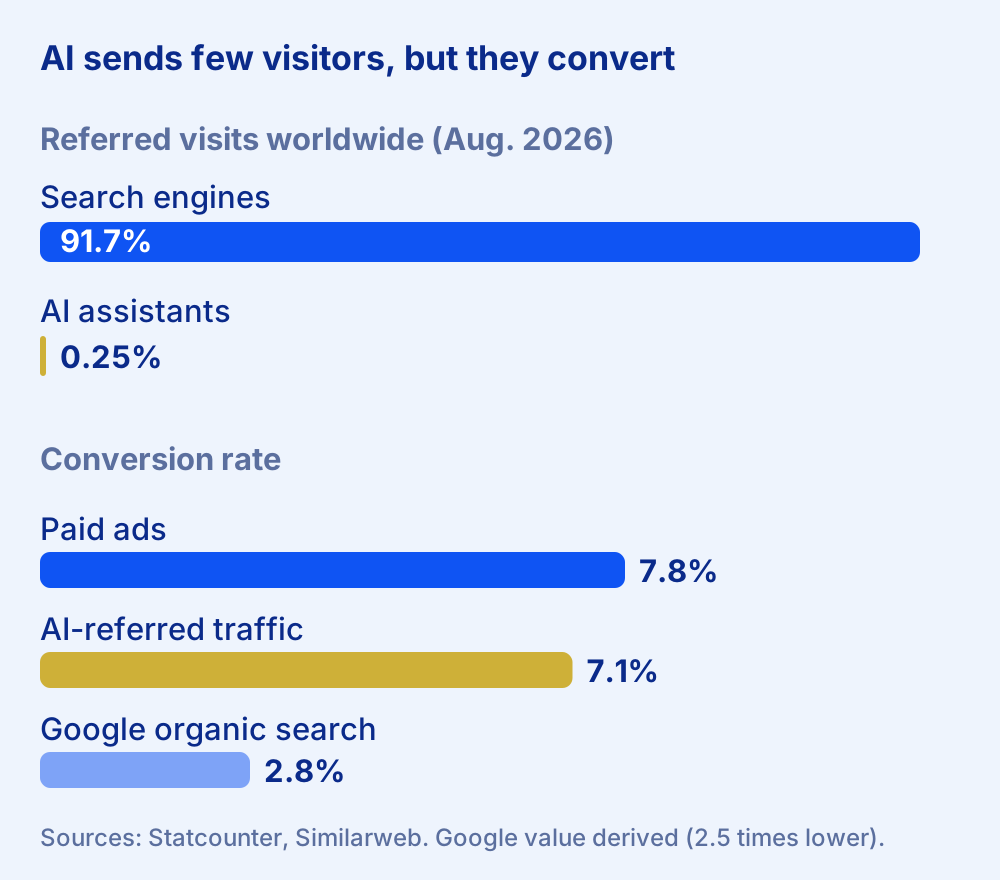
In 2024, Gartner predicted that search volume on traditional engines would drop 25% by 2026. In October 2026, the picture is more nuanced: according to Statcounter, AI chatbots sent only 0.25% of referred visits worldwide in August 2026, versus about 92% for search engines, and Ahrefs noted in February 2026 that Google sends about 190 times more traffic to websites than ChatGPT. But those visitors are worth more: according to Similarweb, AI-referred traffic converts at 7.1%, 2.5 times better than Google organic search.
Companies that structure their content to be cited today get a head start their competitors will have to catch up on later, when everyone starts at the same time.
Concretely, that means appearing in the list of sources cited under an answer, or being named directly in the AI-generated text, the 2026 version of a first position on Google.
That's exactly the work we do with our GEO optimization service: structuring your content, adding structured data and showing you precisely what an AI already says about you today.
Go further
Ready to get cited by AI?
We audit your current presence in AI answers and put the foundations of GEO in place for your business.