Since February 2026, you can buy advertising inside ChatGPT. It's the first ad network built around a conversation rather than a query, and using it doesn't resemble what you know from Google.
Here's how it actually works.
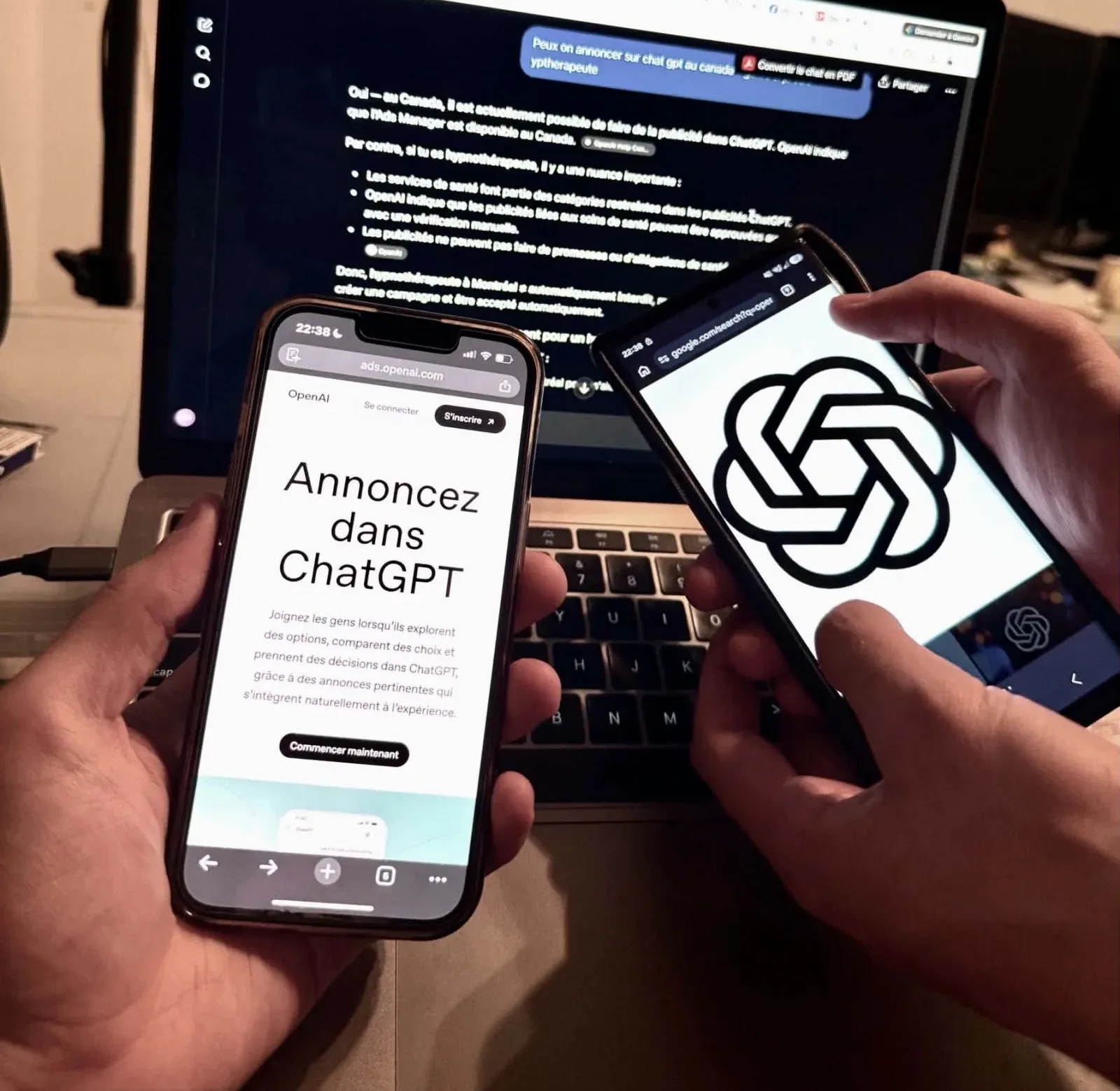
October 2026 update: ChatGPT advertising is available in Canada
OpenAI began showing ads to Free and Go users in Canada on April 16, 2026. The self-serve Ads Manager (ads.openai.com), opened to US businesses on May 5, 2026, now lists Canada among its markets according to several sources. Sources differ on the minimum: some mention a daily budget of about C$25, others no minimum. Health, financial and legal services are generally prohibited outside the United States. Check the terms in your account before budgeting.
What changed in February 2026
OpenAI began testing advertising in ChatGPT on February 9, 2026, with adult users on Free and Go plans in the United States, with a gradual rollout by country. La Presse picked up the AFP wire the next day.
Three points to keep in mind before going further. First, ads only show for Free and Go plans: Plus, Pro, Business, Enterprise and Edu accounts see none. Second, a user can turn them off, but their daily free messages are then reduced, so in practice most keep them. Finally, availability varies by country: in Canada, ads have been showing since April 16, 2026 and self-serve is available, but you should check your industry's rules before building a budget.
Why OpenAI is opening advertising now
The context helps explain why this network will grow fast, and therefore why today's bids won't stay at this level.
According to AFP, only a fraction of ChatGPT's billion users subscribe, while the computing power required costs enormous sums. OpenAI is aligning its model with Google's and Meta's, whose strength rests on advertising attached to free services.
A network that has to fund infrastructure at that scale won't stay quiet for long. That's exactly the window where the cost of entry is lowest.
The speed of adoption explains the rest. Radio-Canada reported as early as February 2023 that ChatGPT had reached 100 million monthly active users in January, just two months after opening to the public on November 30, 2022. Analysis firm UBS, citing Similarweb, called it the fastest ramp-up ever observed for a consumer web application: roughly 13 million unique visits per day, more than double the previous month. TikTok took close to nine months to pass the same mark, Instagram two and a half years.
Three years later, that same product has a billion users and is opening its advertising inventory. An audience built at that speed does not stay cheap for long.
What an ad looks like
The ad appears below ChatGPT's answer, clearly labelled as sponsored and visually separated. It doesn't influence the answer: the two systems are distinct, and no advertiser can steer, rank or modify what ChatGPT says.
Each ad has six elements: the advertiser name, your favicon, a headline, description text, an image and the landing page.
Targeting: context hints, not keywords
This is the most disorienting difference for anyone coming from Google.
You don't reserve keywords. At the ad group level, you provide context hints: you describe the conversations, topics or needs your offer is relevant to. The system uses them to steer matching, but they aren't exact matches and they guarantee no specific placement.
The system weighs several signals: the context and intent of the current conversation, your landing page, your headline, your text, your context hints, and. if the user has enabled personalization. certain signals from their broader ChatGPT use.
Why that changes everything
On Google you buy three hastily typed words. In ChatGPT, the person has already explained their context, their budget and their constraints before your ad appears. You arrive at the comparison stage, not the search stage.
A concrete example, for a Quebec business
Context-based targeting stays abstract until you apply it. Take an accounting firm in Laval looking for new business clients.
On Google, you buy three phrases: "accountant Laval", "bookkeeping business", "small business taxes". You know nothing about the person typing them. They could be an individual, an accounting student, or a competitor checking your position.
Inside ChatGPT, by the time your ad can appear, the person has often already written something like this:
I run a construction company with 12 employees in Laval. My current accountant hasn't answered my emails in two months and I'm behind on GST remittances. I'm looking for someone who can take over quickly, handle payroll, and I can spend around $400 a month.
A real pre-purchase conversation
the kind of context Google never gives you
So you don't reserve keywords. You describe situations. For that firm, the context signals would look like this:
- ✓Quebec small business with 5 to 50 employees looking for an accountant
- ✓Business unhappy with its current accountant or left without service
- ✓Needs payroll management and GST and QST remittances
- ✓Owner behind on tax obligations and in a hurry to catch up
- ✓Looking for a firm in the Laval, Montreal or Laurentians area
The difference is visible: Google sells you a three-word intent, ChatGPT puts you in front of someone who has already described their problem, their urgency and their budget.
One detail that matters in Quebec: these conversations happen in French. Your context signals, your headlines and your landing page need to be in French to match. It's obvious, and it will still be missed by advertisers who mechanically translate campaigns designed in Toronto.
Pricing
Two possible objectives, and you choose based on what you're after:
| Objective | What you optimize | What you pay |
|---|---|---|
| Reach | Impressions | Per thousand impressions (CPM) |
| Clicks | Clicks | Per valid click (CPC) |
You set a maximum bid at the ad set level. OpenAI recommends starting between $3 and $5 USD per click for CPC campaigns, and the Ads Manager indicates whether your bid risks limiting delivery.
Selection runs through second-price auctions weighted by relevance. In other words, a highly relevant ad can beat a higher bid that's less well aligned. That's good news for well-targeted small businesses.
Measuring results
The Ads Manager reports impressions, clicks, spend, click-through rate, average cost per click, average CPM and conversions.
Two things to configure from the start, otherwise you're flying blind: conversion measurement in the Ads Manager, and UTM parameters on your landing pages. Those parameters survive the click, which makes ChatGPT traffic visible in your existing analytics instead of landing in a “direct” bucket.
What your competitors won't see
OpenAI doesn't share conversations with advertisers and doesn't sell user data. You receive only aggregated, non-identifying reports: views, clicks, conversions.
No advertiser has access to chats, history, memories or personal information. If someone promises you targeting based on conversation content, they aren't describing this product.
Limits to know before budgeting
- ✕No advertising near sensitive conversations: health, mental health, politics.
- ✕Political advertising isn't allowed for now.
- ✕Nothing appears in temporary chats or for accounts identified as under 18.
- ✕Regulated sectors, such as healthcare and financial services, go through strict eligibility criteria.
- ✕In Canada, health, financial and legal services are generally prohibited from advertising: check your industry's rules before planning a budget.
What we prepare, concretely, before launching
The network is open in Canada, but the first weeks of a new ad network are expensive in learning. The real question isn't "when do I launch", but "what can I have ready before spending my first dollar". Here is our list.
The account and business verification
Creating the advertiser account and verifying identity takes administrative time, not talent. It may as well be done in advance.
Context signals, written then tested
We write out the situations where your offer is relevant, as in the example above. Then we confront them with reality: we ask ChatGPT the questions your clients would ask and watch which phrasings come back, so the signals describe conversations that actually happen rather than ones we imagined.
The creatives
Headline, description and visual. The format is short and the space is tight: every word has to carry. We prepare several versions so we can compare from the first days instead of waiting a month for a second option.
The landing page
This is the part most advertising agencies don't do, because they don't write code. A paid click landing on a slow, vague page with no way to reach you is a wasted click. We build it. It's the same work as on our projects, with the form, the speed and the tracking that go with it.
Conversion tracking
Without measurement, a campaign is an opinion. We set up tracking before the first dollar is spent, not three weeks in when we're trying to work out what happened.
The baseline reading
Before launching anything, we record where you stand: do you already come up in ChatGPT, Perplexity and Copilot answers for your key questions, and how are you described? Without that starting picture, you'll never be able to show the campaign changed anything. It's the same reading as in our GEO optimization offering.
Where to start
If you want to do it yourself: create an account in the Ads Manager, set up a first campaign with a Clicks objective, a starting bid between US$3 and US$5, and context signals that precisely describe the situations where your offer is useful. Measure for two weeks before touching anything.
If you'd rather we handled it, that's exactly the service we built. Going through an agency changes four concrete things.
You don't learn on your own budget. The first weeks on a new ad network are mostly spent figuring out what the system rewards. When we run it, those lessons come from our other clients' campaigns and are already paid for.
Context signals are written, not guessed. This is the piece that decides whether your ads show at all. Describing the situations where your offer is relevant, then correcting them based on the conversations that actually trigger your impressions, takes rounds of adjustment nobody gets right on the first try.
Your ads lead somewhere. A paid click landing on a slow, vague page with no way to reach you is a wasted click. We also build the landing page, the form and the tracking, because that's where a campaign turns into a contract.
You keep the full picture. ChatGPT is only one of the surfaces where people look for you. A dollar is sometimes better spent there than elsewhere, sometimes not, and that answer changes by month and by industry.
Advertising inside ChatGPT is part of our digital visibility offering, alongside search optimization, positioning inside AI-generated answers, and Google campaigns.
Go further
Frequently asked questions
Does advertising influence what ChatGPT answers?
No. OpenAI describes two separate systems: the answer is generated independently, and the ad appears below it, labelled as sponsored. Buying a placement doesn't get you recommended inside the answer text. For that, the underlying GEO work is what counts.
What's the difference from Google Ads, in one sentence?
On Google you buy keywords, inside ChatGPT you describe situations, and the person has often already explained their context, budget and constraints before your ad appears.
How much should you budget to start?
OpenAI recommends a starting bid between US$3 and US$5 per click. For a test that produces usable data rather than an impression, plan at least two weeks of continuous delivery without touching the settings. The ad budget is separate from management fees.
Is my industry eligible?
Regulated industries such as health, mental health and financial services go through stricter eligibility criteria, and political advertising isn't allowed. Nothing shows in temporary chats or for accounts under 18 either. It's one of the first things we check for you.
Is it available in Quebec now?
Testing began on February 9, 2026 in the United States and availability is opening country by country. We check weekly and will tell you frankly if it isn't open for your market yet. What's doable today is all the preparation described above.
Why hurry if it isn't open here yet?
Because an ad network's entry cost is at its lowest when it opens, and the first weeks are mostly spent figuring out what the system rewards. Those arriving two years later buy that knowledge back at full price, on top of bids that have become competitive.
Sources
OpenAI. Ads in ChatGPT: the basics. Format, selection, delivery, pricing and measurement. OpenAI Help Center. View
OpenAI. Our approach to advertising. Principles, independence of answers and the controls offered to users. View
OpenAI Ads. Ads Manager. Country availability, campaign creation and advertiser documentation. View
La Presse, Agence France-Presse. February 10, 2026. “ChatGPT has begun testing advertising”: launch date, plans affected, user numbers. View
Radio-Canada. February 2, 2023. "ChatGPT sets the record for the fastest-growing user base": the 100-million-user mark, the UBS study citing Similarweb, comparison with TikTok and Instagram. Read
The figures and rules described on this page come from OpenAI's official publications and from media coverage. Checked on August 16, 2026; this information evolves, so confirm with the source before any budget decision.
We run your ChatGPT campaigns end to end
Strategy, account setup, copy, context hints, conversion measurement and ongoing optimization. We check availability in your market first, and tell you plainly if it isn't open yet.