"What's the best AI?" is the question we get most often since ChatGPT, Claude, Gemini and the others moved into everyday business life. The real answer is less simple than a ranking: it depends on what you do with it.
We compared six AI assistants (ChatGPT, Gemini, Perplexity, Claude, Grok and Cohere) on their place in the market in Quebec and France, their price, their strengths and their limits, then ranked the uses rather than declaring a single winner.
Quick answer
There is no single best AI. ChatGPT is the most used and most versatile, Claude is most often chosen for writing and coding, Gemini integrates with Google, Perplexity cites its sources, Grok follows X live and Cohere targets businesses. Most plans cost about $20 a month.
Summary: the answers in 30 seconds
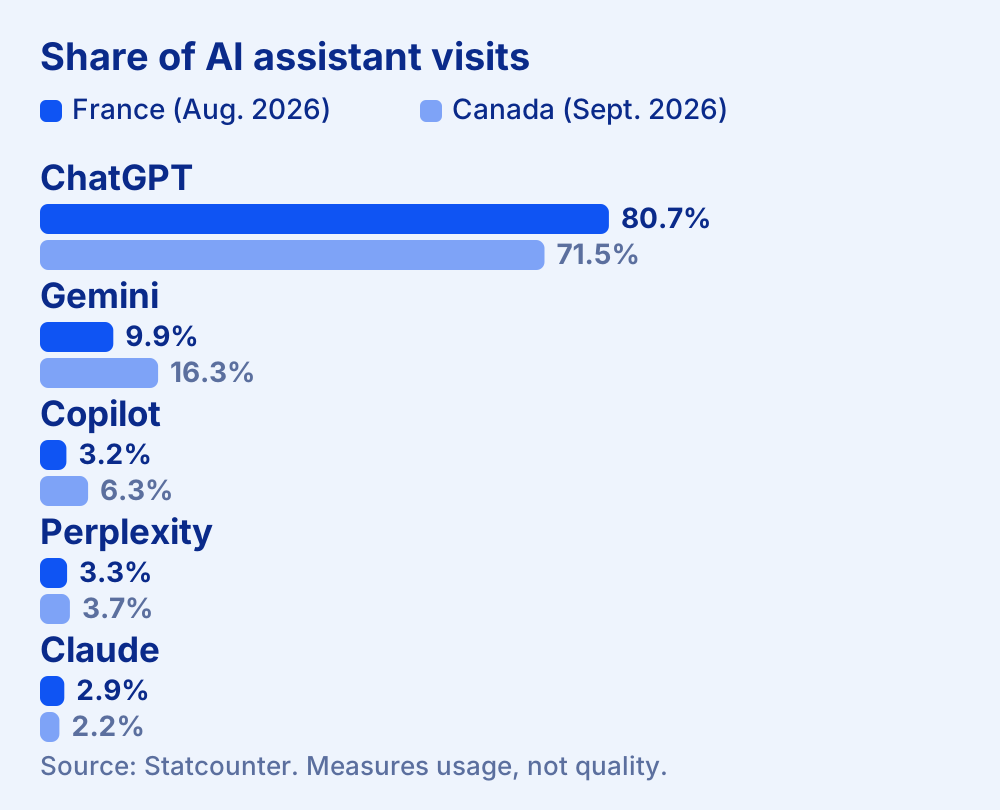
- ✓Which is the most used? ChatGPT: about 81% of visits in France (August 2026) and 71% in Canada (September 2026), according to StatCounter.
- ✓Which for writing and coding? Claude, according to most comparisons we reviewed.
- ✓Which for searching with sources? Perplexity.
- ✓Which to use with Google? Gemini.
- ✓Which for a business that wants a private AI? Cohere (North platform).
- ✓How much does it cost? About $20 a month for ChatGPT, Claude, Gemini and Perplexity, $30 for SuperGrok.
How did we compare these AIs?
We looked at four things: measured market share (StatCounter for France in August 2026 and Canada in September 2026), the price of entry-level paid plans, strengths and limits reported by public comparisons, and position in quality rankings like LMArena. Models change several times a year: figures are current as of October 8, 2026, some sources contradict each other, and we flag it when they do.
Transparency: at Oriana Solutions, we mostly build with Claude, and we test ChatGPT, Perplexity, Gemini and Copilot answers for our clients' visibility. This article doesn't compare these tools in a house benchmark: it gathers public data.
How much does each AI cost?
The entry-level paid plan is around $20 a month almost everywhere.
| AI | Base plan | Higher tiers |
|---|---|---|
| ChatGPT | Plus: $20/month (a cheaper entry plan exists, between $6 and $8 depending on sources) | Up to $200/month |
| Claude | Pro: $20/month (about $17 if annual) | Max: $100 or $200/month |
| Gemini | AI Pro: about $20/month | Top tier: about $200 to $250/month depending on sources |
| Perplexity | Pro: $20/month | Max: $200/month |
| Grok | SuperGrok: $30/month | Top tier: about $300/month |
| Cohere | No consumer subscription: pay-as-you-go API | North (enterprise platform): on request |
Prices in US dollars, taken from 2026 public comparisons that sometimes diverge. Check each vendor's site before subscribing.
What are the 6 AIs, one by one?
Here is the detail of each, from the most used to the most specialized.
ChatGPT (OpenAI): the most used in France
Publisher: OpenAI (United States).
Market share: 80.7% in France, 71.5% in Canada.
Price: Plus at $20/month.
- ✓Strengths: The most versatile and the one with the most features (text, images, voice, file analysis, search, agents). It's also the best known to your customers, so the one where being cited matters most.
- ✓Limits: Not always at the top of quality rankings, ads being tested in free plans since February 2026, and a declining worldwide market share.
- ✓Who it's for: Almost everyone: individuals, SMEs, teams that want one tool to do everything.
- ✓Best for: A first general-purpose assistant, or when you want the widest range of features.
Gemini (Google): the AI built into Google
Publisher: Google (United States).
Market share: 9.9% in France, 16.3% in Canada.
Price: AI Pro at about $20/month, with a generous free tier.
- ✓Strengths: Integration with Gmail, Docs, Drive and Google Search, a free tier described as generous in several comparisons, and models that sit in the leading pack of rankings.
- ✓Limits: Most useful if you already live in Google's ecosystem; less compelling otherwise.
- ✓Who it's for: Teams using Google Workspace, students and people who want a good free AI.
- ✓Best for: Summarizing emails and documents, searching your own Google Drive.
Perplexity: search with sources
Publisher: Perplexity AI (United States).
Market share: 3.3% in France, 3.7% in Canada.
Price: Pro at $20/month, Max at $200/month.
- ✓Strengths: Every answer cites its sources, which makes checking easy. Ideal for research, monitoring and competitor analysis.
- ✓Limits: Built for searching, not creating: less suited to long-form writing or code. The free tier limits advanced searches per day.
- ✓Who it's for: Researchers, journalists, managers who do monitoring.
- ✓Best for: Quickly finding recent information along with its sources.
Claude (Anthropic): writing and coding
Publisher: Anthropic (United States).
Market share: 2.9% in France, 2.2% in Canada.
Price: Pro at $20/month, Max at $100 or $200/month.
- ✓Strengths: Often named the best for long-form writing and coding. Its models lead several quality rankings as of October 2026, and Claude Code is one of the most used agentic coding tools.
- ✓Limits: Consumer market share still small, and tighter usage limits on the base plan according to some comparisons.
- ✓Who it's for: Writers, developers and analysts working with long documents.
- ✓Best for: Drafting, editing, analyzing long texts and writing code. See our vibe coding tools.
Grok (xAI): X's real-time data
Publisher: xAI (United States).
Market share: not ranked in the data we reviewed.
Price: SuperGrok at $30/month.
- ✓Strengths: Access to X conversations and trends in real time, a more direct tone, and competitive models: an August 2026 ranking places Grok 4.3 in the leading pack, slightly behind the top.
- ✓Limits: A pricier plan than competitors, strongly tied to the X platform, and professional use is still uncommon.
- ✓Who it's for: People who follow the news and social media closely.
- ✓Best for: Taking the pulse of a news topic or a trend on X.
Cohere: the private AI for businesses
Publisher: Cohere (Toronto, Canada).
Market share: not ranked (enterprise tool, no consumer app).
Price: pay-as-you-go API; the North platform is on request.
- ✓Strengths: A Canadian vendor focused on businesses: Command models, the North platform for private agents, private or on-premises deployment, and support for dozens of languages, including French.
- ✓Limits: No consumer app, unpublished enterprise platform pricing, and sources diverge on some technical details. Setup requires a technical team.
- ✓Who it's for: Banks, insurers, large companies and organizations that don't want to send their data to a public service.
- ✓Best for: Searching your internal documents with an AI that stays in-house.
Bonus: what about Mistral, the French AI?
Mistral AI (Paris) offers Le Chat, an assistant whose Pro version costs about $15 a month and runs on Mistral Large 3. It's not the most used in France (it doesn't appear in StatCounter's ranking), but it's a coherent choice if you want a European company and an AI that's strong in French.
And the new AI agents: Muse, Grok Bot and Dots?
In September 2026, Meta (Muse), xAI (Grok Bot) and OpenAI (Dots) launched agents that work in your place on their own computer. They aren't just more assistants: they act, not only answer. We compare them in our article Muse, Grok Bot and Dots: what's the difference?
Which AI should you choose for the task? Our map
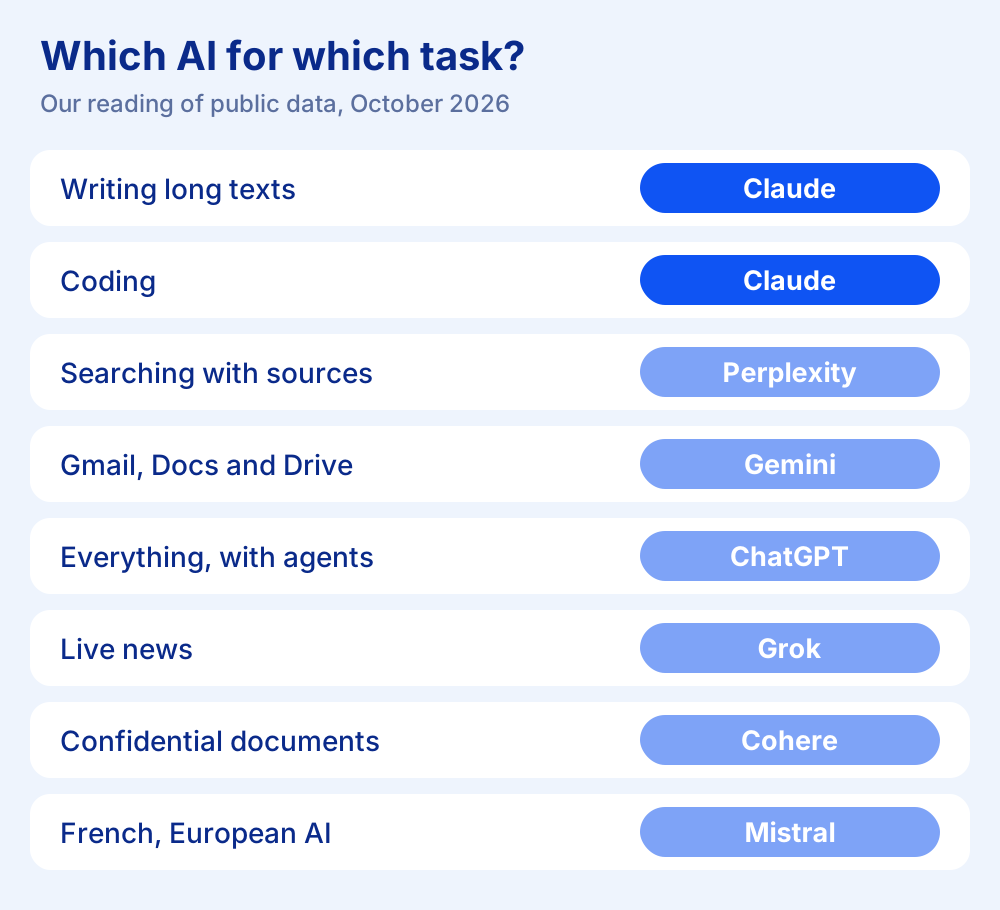
Here is the AI we'd reach for first for each task, based on public data from October 2026 (rankings, independent measurements, features and prices). It isn't a house test: we state the evidence behind each pick.
Writing and editing long texts
- ✓Best pick: Claude.
- ✓Why: Anthropic's models hold six of the top seven spots in the LMArena blind ranking (August 31, 2026), with Claude Fable 5 in first place, and comparisons name it first for long-form writing.
- ✓Example prompt: "Write a two-page service offer for a restaurant website in Laval, warm tone, with three packages and a timeline."
- ✓Limit: Tighter usage limits on the base plan, according to some comparisons.
Coding and fixing code
- ✓Best pick: Claude, then ChatGPT with Codex.
- ✓Why: Independent measurement by Artificial Analysis: Claude Opus 5.5 scores 59.6% on Terminal-Bench 4.0 (command-line work), versus 26% for Grok 4.7.
- ✓Example prompt: "In this Next.js project, add email sign-in and write the tests."
- ✓Limit: You need to be able to review the code it produces. See our vibe coding tools.
Searching with sources
- ✓Best pick: Perplexity.
- ✓Why: Every answer cites its sources, so you can check before relying on a figure.
- ✓Example prompt: "What are the 2026 prices of HubSpot, Pipedrive and monday CRM for 10 users? Cite your sources."
- ✓Limit: Built for searching, less for creating. Advanced searches are limited per day on the free tier.
Working in Gmail, Docs and Drive
- ✓Best pick: Gemini.
- ✓Why: Built into the Google ecosystem, with a free tier described as generous by several comparisons.
- ✓Example prompt: "Summarize this week's unread customer emails and list what's urgent."
- ✓Limit: Less useful if you're not in the Google ecosystem.
One tool for everything, with agents
- ✓Best pick: ChatGPT.
- ✓Why: About 81% of AI assistant visits in France and 71% in Canada, more than 4,000 connected apps with dots, and text, image and voice features.
- ✓Example prompt: "Plan my content week, then save the draft in my Drive."
- ✓Limit: Not always at the top of quality rankings, and ads in the free plans.
Following the news live
- ✓Best pick: Grok.
- ✓Why: Access to X conversations and trends in real time.
- ✓Example prompt: "What are people saying on X this morning about the new digital services tax? Give five points and the accounts driving the discussion."
- ✓Limit: A pricier plan (about $30 a month) and tied to the X platform.
Searching confidential documents
- ✓Best pick: Cohere, or a custom private AI.
- ✓Why: A Canadian vendor focused on businesses, with private deployment that keeps your documents in-house.
- ✓Example prompt: "In our customer contracts, find the termination clause and summarize it."
- ✓Limit: No consumer app, unpublished pricing, set up by a technical team.
Working in French with a European AI
- ✓Best pick: Mistral.
- ✓Why: A Paris company whose latest model, Mistral Large 4, came out on October 6, 2026.
- ✓Example prompt: "Write a follow-up letter in formal French for an invoice unpaid for 45 days."
- ✓Limit: Absent from Statcounter's market-share ranking: less used.
The latest model from each AI
Here is each AI's most recent model as of October 9, 2026, with its release date, context size (how much text it can read at once) and API price.
| AI and latest model | Release and context | API price (input / output, per million tokens) |
|---|---|---|
| ChatGPT: GPT-6 Astra | September 3, 2026, 1.05M tokens | $10 / $50. Cheaper: GPT-6.1 Sol (September 29), $2 / $10 |
| Claude: Opus 5.5 | September 22, 2026, 1M tokens | $4 / $20. More powerful and pricier: Fable 5.1, $10 / $50 |
| Gemini: 3.8 Flash | September 2, 2026, 1M tokens | $0.75 / $3.75 (promotion through December 31). Gemini 3.1 Pro is still in preview, $2 / $12 |
| Grok: 4.7 | September 21, 2026, 500,000 tokens | $2 / $6 |
| Perplexity | No flagship model of its own found: the product is built on search with sources | Pro subscription at $20 a month |
| Cohere: Command A+ | Cohere documentation: 48 languages, 128,000-token context (other sources say 192,000) | API price unconfirmed, North platform on request |
| Mistral: Large 4 | October 6, 2026, 1M tokens | $0.68 / $2.09 (launch price), then $1.36 / $4.18 |
Public prices in US dollars, from vendor pages and comparisons consulted on October 9, 2026. Prices vary by provider and some are promotional. No source gives the same current quality score for all these models: see the next section.
What do the quality rankings say?
The LMArena blind ranking, where users compare two answers without knowing which AI wrote them, puts six Anthropic models among the top seven (August 31, 2026 snapshot): Claude Fable 5 first at 1507, Claude Opus 4.6 at 1505 and Opus 4.7 at 1502. Meta's Muse Spark 1.2 is 4th at 1498. The top ten sit within 18 points (1507 to 1489), a gap you can't notice in use.
At the launch of the September models, Artificial Analysis's independent measurement gave Claude Opus 5.5 a 58, Claude Fable 5.1 and GPT-6 Astra a 53, and GPT-5.6 Sol a 47. Gemini 3.8, Grok 4.7 and Mistral Large 4 weren't on it yet, and the scale has been revised since August: don't compare these figures with earlier ones.
The takeaway: Claude leads the quality rankings, but the gap with the others is small. The choice comes down mostly to the task, the price and the features, as in the map above.
Which AI is safest for your data (Law 25)?
Law 25 requires you to assess risks before transferring personal information outside Quebec, and sending that data to a US AI assistant is one. Before pasting customer information into a tool, ask three questions:
- 1Where does processing run, and where is my data stored?
- 2Are my conversations used to train the model?
- 3Which subprocessors have access?
Enterprise plans from the big vendors and players like Cohere generally let you turn off training on your data. For sensitive uses, a private AI or one built into your software is often the best option: see our page on AI and agent integration.
And which AI do your customers use to find you?
Your customers don't use an AI only for themselves: they also use it to find a supplier like you. In Canada, about 71% of AI assistant visits go to ChatGPT, 16% to Gemini and 4% to Perplexity (Statcounter, September 2026).
Concretely: if someone asks ChatGPT "which firm should I choose for a web app in Longueuil?" and your site is cited, the request comes to you. If not, it goes to a competitor. Our free GEO training and our GEO optimization page explain how to get cited.
Want to integrate AI into your operations?
We help you choose the tool, integrate it into your software and automate repetitive tasks, with your data protected.
Go further
What's the best AI in 2026?
There's no single winner. ChatGPT is the most used and most versatile, Claude is most often chosen for writing and coding, Gemini integrates with Google, Perplexity cites its sources, Grok tracks X in real time and Cohere targets businesses. The best choice depends on your use.
Which AI is the most used in France?
ChatGPT, with about 80.7% of visits in August 2026 according to StatCounter, far ahead of Gemini (9.9%), Perplexity (3.3%), Copilot (3.2%) and Claude (2.9%).
Which AI is best for writing or coding?
Claude is most often cited by comparisons for long-form writing and coding, with ChatGPT and Gemini close behind.
ChatGPT, Claude or Gemini: which is free?
All three have a free tier with usage limits. Gemini is often described as the most generous, but limits change regularly.
What is Cohere?
Cohere is a Canadian company based in Toronto that sells AI models and the North platform to businesses. It doesn't offer a consumer app comparable to ChatGPT.
Can you use ChatGPT with customer information in Quebec?
Only with care. Law 25 requires an assessment before any transfer of personal information outside Quebec. Use an enterprise plan that excludes training on your data, or a private AI, and anonymize when possible.
- 1.StatCounter — AI Chatbot Market Share in France (August 2026)
- 2.StatCounter — AI Chatbot Market Share in Canada (September 2026)
- 3.TechCrunch — ChatGPT's market share slips below 50% for first time (June 16, 2026)
- 4.LMArena — Model quality rankings, as seen by aggregators (October 2026)
- 5.Price Per Token — Comparison of ChatGPT, Claude, Gemini and other subscriptions (2026)
- 6.Cohere — Command A+ documentation
- 7.Tech Jack Solutions — Mistral's Le Chat and its models