In a few weeks, three AI giants launched almost the same idea under three different names: Muse at Meta, Grok Bot at xAI and Dots at OpenAI (inside ChatGPT). All three promise an assistant that doesn't just answer, but works in your place, even after you've closed the app.
If you can't see the difference, that's normal: the names are similar, and so are the promises. This guide untangles them with specific examples of what each can do, the strengths and limits of each, who it's for, what it costs, where it's offered, and what it changes in your daily life. We update it as the products evolve.
Quick answer
Muse (Meta), Grok Bot (xAI) and Dots (OpenAI) are AI agents that work on their own cloud computer. Muse is a personal agent, Grok Bot a team of AI colleagues for repetitive work, and Dots an always-on agent plugged into ChatGPT. All three are new, and none has been independently tested.
Summary: the answers in 30 seconds
- ✓What are they? AI agents: assistants that act on a cloud computer without you being in front of the screen.
- ✓Muse (Meta): a personal agent (errands, forms, family, finding suppliers). Launched September 8, 2026. Free, then $20 or $100/month.
- ✓Grok Bot (xAI): named "colleagues" for sales, marketing and operations. Beta since August 11, 2026. Included with SuperGrok or Cursor.
- ✓Dots (OpenAI): an always-on agent in ChatGPT, strong at research, reports and publishing. Announced September 29, 2026. From $100/month.
- ✓Easiest to try? Muse, which has a free tier, if the service is offered where you live.
- ✓Most useful for work? Dots and Grok Bot, depending on the tool you already pay for.
- ✓Can they act alone? Rarely: almost all official examples stop at a draft or a list to approve.
- ✓Should you trust them? Not for critical work: they're new and their makers admit they can make mistakes.
Last updated: October 8, 2026
- 1All three products change every week. Prices and availability come from publisher documentation and third-party comparisons that sometimes contradict each other, and test results come from the publishers or isolated independent testers. Always confirm on the publisher's site.
What's the difference between a chatbot and an AI agent?
A chatbot like ChatGPT, Claude or Gemini answers when you write to it. An AI agent takes action: it opens websites, signs into your apps, fills in forms, drafts and sends messages (with your approval) and keeps working after you've left.
To do that, each of the three products gives the agent:
- ✓Its own cloud computer, with a browser, separate from yours.
- ✓Connections to your apps: email, calendar, online stores, business tools.
- ✓A memory that keeps your preferences from one conversation to the next.
- ✓Guardrails: rules that decide when the agent acts alone and when it must ask your permission.
How did we get here? The timeline
It all happened in five months.
| Date | Event |
|---|---|
| April 8, 2026 | Meta launches Muse Spark, the first model of the Muse family |
| August 11, 2026 | xAI opens the Grok Bot beta |
| September 3, 2026 | OpenAI releases GPT-6 Astra, the model behind dots |
| September 8, 2026 | Meta launches Muse, its personal agent, in the United States |
| September 29, 2026 | OpenAI announces dots at its DevDay conference, and Meta announces Muse for small businesses |
Dates from publisher announcements and the specialized press.
Muse, Grok Bot and Dots: the comparison table
Here are the three products side by side.
| Product | Publisher and launch | Price |
|---|---|---|
| Muse | Meta, September 8, 2026 (Muse Spark model) | Free (limited), Power $20/month, Maximum $100/month |
| Grok Bot | xAI, beta on August 11, 2026 (Grok 4.7 model according to one source) | Not sold alone: included with SuperGrok (from $30/month) or Cursor (from $20/month) |
| Dots | OpenAI, September 29, 2026 (GPT-6 Astra model) | First dot included in ChatGPT Pro ($100, $200 or $500/month) and Business Premium |
Prices in US dollars, from publisher documentation and public comparisons as of October 2026. They change fast: confirm before subscribing.
Where is each agent offered?
Availability is the first practical difference, especially for a Quebec business.
| Product | Where | Detail |
|---|---|---|
| Muse | United States, Canada confirmed for the small business offer | Consumer launch in the US. No timeline published elsewhere. Ages 18 and over. |
| Grok Bot | Paying SuperGrok or Cursor subscribers | The agents' computers are in the United States. Enterprise offer on a waitlist. |
| Dots | Outside the European Economic Area, the UK and Switzerland (Pro plans) | Business Premium offered in all ChatGPT regions. Enterprise and education: beta enabled by the admin. |
Sources diverge on some availability details for Muse and Dots. Check the publisher's site.
The three agents in detail
For each: what it does concretely, its specifics, strengths, limits and who it's for.
Muse (Meta): the personal agent for everyday life
Publisher: Meta (Meta Superintelligence Labs).
Launch: September 8, 2026, in the United States, on iOS, Android, the web and WhatsApp (and a Mac app).
Model: Muse Spark family.
Price: free (limited, with a payment card requested at signup), then $20/month (Power) or $100/month (Maximum).
- ✓Specifics: a single agent you name and customize, with persistent memory, a library of documents, sites, images and podcasts, and an activity feed that shows every step. A component called Sentinel must approve every online action, and payments go through one-time cards (Stripe Link).
- ✓Strengths: the easiest to pick up (one of the simplest to set up according to a tester), very polished design (a tester found its family morning PDF more beautiful than what they'd produced with Claude or Codex), and a free tier.
- ✓Limits: limited availability, fewer connected apps than technical tools, accounts missed in one test, uneven online purchases, and a sense of discomfort among testers as they give it access to their digital life.
- ✓Who it's for: individuals, families and very small businesses that want to delegate everyday logistics and supplier searches.
What Muse can do: specific examples
Here are tasks actually tried by testers and examples given by Meta:
- ✓Fill in a school form from an email you received.
- ✓Track a price to book at the right moment, or follow up with an airline about a late refund.
- ✓Find a mover: a tester turned this painful search into a quick back-and-forth that produced several quotes.
- ✓Manage the family calendar (for example deleting a soccer practice) and produce a family morning newsletter as a PDF.
- ✓Track personal goals: water intake, shoes, sleep training.
- ✓Buy movie tickets: "much better" than buying shoes, which was "not great" according to the same tester.
- ✓Negotiate on Facebook Marketplace: Muse couldn't message sellers directly in a CNN test and drafted a message instead. Meta says it can negotiate within limits you set.
- ✓Shop: at Target, it browsed the site, but the user had to enter their details, because the retailer blocks autonomous clicks at checkout.
Real example at Oriana: Muse as a "setter"
At Oriana Solutions, we use Muse as a setter, meaning for the first contact with prospects. It watches the news online and, based on a news item, drafts and sends an introduction message to the business concerned. A typical example: a company announces an opening, funding or a new contract, and Muse writes a first message that refers to that news.
It's a good example of what these agents do well: a repetitive task, based on public information, with a short message. To keep quality up, we keep clear rules: a validated tone, a list of target companies and approval before any important send.
Grok Bot (xAI): AI colleagues that hand work to each other
Publisher: xAI.
Launch: open beta on August 11, 2026, still in beta.
Model: Grok 4.7 according to one source, but xAI hasn't confirmed it and you can't choose.
Price: not sold alone. Included with SuperGrok (Plus and Heavy) and Cursor plans (sources diverge on whether Cursor Pro is included).
- ✓Specifics: several named "Bots", visible like an org chart, that work in parallel, message each other and share a persistent computer. You show them a job once, and they turn it into a routine (scheduled or triggered). Enterprise controls include single sign-on, an audit log and allowed-address lists.
- ✓Strengths: the most complete for teamwork: xAI offers 56 predefined roles in 9 categories (general, sales, marketing, support, recruiting, finance, product, engineering, everyday life). The best choice for repetitive tasks across several tools.
- ✓Limits: still in beta, no model choice, all your Bots share the same computer (xAI states Bots are not security boundaries), computers in the United States, a weekly quota that stops dead at 100%, and routines that can't be triggered by an incoming email according to one analysis.
- ✓Who it's for: sales, marketing, operations and support teams that already pay for SuperGrok or Cursor.
What Grok Bot can do: specific examples
Here is a selection of xAI's official roles:
- ✓Sales: “Sales Outbound” researches accounts overnight, scores contacts and drafts emails and LinkedIn messages, then leaves a list to approve. “Renewal Desk Operator” prepares a 90-day pack per customer. “Sales Call Coach” gives timestamped feedback on your recorded calls.
- ✓Marketing: “SEO / AEO Auditor” tracks keywords and the questions asked to AIs, “Competitive Intelligence Analyst” watches competitor launches, “Paid Media” recommends budget changes and waits for your approval.
- ✓Support: “Ticket Triage Specialist” monitors ticket queues and drafts replies without sending them.
- ✓Finance and operations: “Invoice Coordinator”, “Expense Manager”, “Security Questionnaire Filler” (fills in vendor security questionnaires), “Vendor Portal Operator” (runs routine tasks on portals without APIs).
- ✓Engineering: “Bug Reproduction” reproduces a reported bug and delivers a pack with screenshots, “Prototype Builder” delivers a clickable prototype with a link.
- ✓Everyday life: “Apartment Scout” filters listings, “Subscription Cleaner” spots subscriptions to cancel, “Travel Coordinator” compares flights and hotels against your rules, “Personal Site Builder” creates a personal site.
- ✓Customer case reported by xAI: a 175% rise in tickets handled without adding staff, with a resolution cost as low as $0.20 to $0.30. That's the publisher's figure, unverified.
In practice, testers note that almost all official examples stop at a draft or a review list: the sales role explicitly says not to send anything. Plan to approve every message yourself.
Dots (OpenAI): ChatGPT's always-on agent
Publisher: OpenAI.
Launch: announced at the DevDay conference on September 29, 2026.
Model: GPT-6 Astra.
Price: a first dot included in ChatGPT Pro ($100, $200 or $500/month) and Business Premium.
- ✓Specifics: one primary agent per user, with its own computer and browser. It connects to more than 4,000 apps, replies through ChatGPT, Slack, Teams or voice, learns your preferences, and has custom rules (act without asking, ask first, hand off). You can open the dot's computer at any time. Specialist dots for businesses (procurement, invoices, support, contracts) are in preview.
- ✓Strengths: research, reports, publishing and recurring work. One tester gave it an average score of 8.8 out of 10 across ten business tasks. It does well when given access to your own computer.
- ✓Limits: weaker on consumer tasks (signing up with an internet provider, ordering food), blocked by some web checks, no virtual card to pay like Muse, spreadsheets whose formulas break in Google Sheets, and follow-ups that are sometimes not send-ready. OpenAI warns dots can make mistakes.
- ✓Who it's for: ChatGPT Pro or Business users who want an always-on assistant for research, reports and publishing.
What Dots can do: specific examples
A tester tried ten business tasks on September 30 and October 1, 2026. Here are the results:
- ✓Compare five AI agent platforms: 9.8 out of 10, no factual errors found.
- ✓Build and publish a web page: 9.8 out of 10, published privately by default with a shareable link, but without following the tester's visual identity.
- ✓Plan a week of content from their existing publications: 9.8 out of 10.
- ✓Report every morning at 9 a.m. on five vendors' product changes: 9.8 out of 10, with a phone notification.
- ✓Prepare a meeting (participants, past decisions, open issues): 9 out of 10.
- ✓Write a weekly report: 8.6 out of 10, excellent as a PDF once requested.
- ✓Triage a week of emails: 7.5 out of 10, but it treated as open an issue the tester had fixed elsewhere.
- ✓Build an Excel workbook: 7.5 out of 10, with formulas that didn't work in Google Sheets.
- ✓Prepare a meeting follow-up: 7 out of 10, the worst result: the message appeared in the conversation rather than as a send-ready draft.
- ✓Early user examples: spotting a forgotten invoice, drafting it from an email thread and sending it as a PDF after approval, or noticing a warranty email and offering to arrange the repair.
Another tester noted the dot improved a lot with access to their own computer: after a ten-minute voice briefing, it rebuilt a personal website and combined video clips for social media within minutes. These results come from isolated testers, not an independent benchmark.
Which agent for which profile?
Our reading, depending on who you are:
| Profile | Agent to try first | Why |
|---|---|---|
| Individual or family | Muse | Free tier, WhatsApp, everyday logistics |
| Solo entrepreneur | Muse or Dots | Light prospecting, research and publishing |
| SME in sales or marketing | Grok Bot | Predefined roles, routines, teamwork |
| Executive who already uses ChatGPT | Dots | Built into ChatGPT, reports and research |
| Development team | Dots or Grok Bot | Dots with Codex, Grok Bot with Cursor |
These recommendations come from our reading of published tests, not a house benchmark.
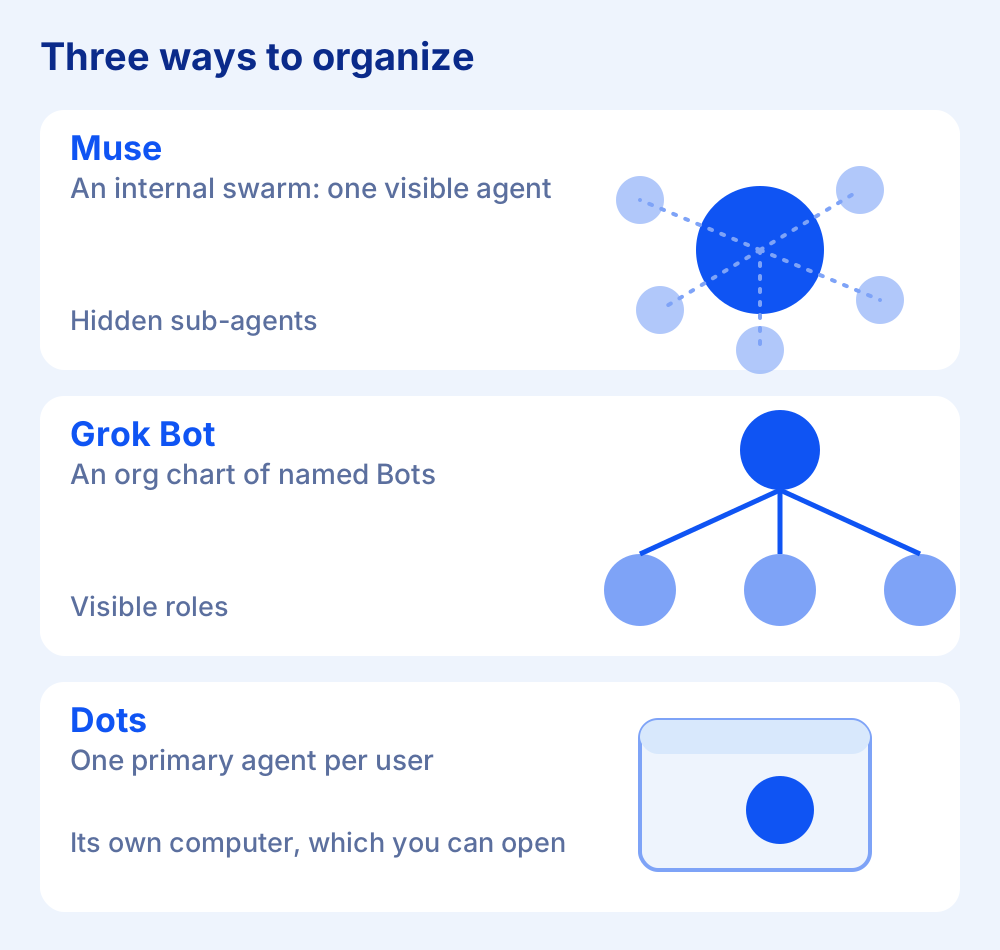
How does each one organize itself: team, swarm or single agent?
This is the real design difference, and it changes how you work with each product.
| Product | Organization | What you see |
|---|---|---|
| Muse | An internal swarm: one visible agent with hidden sub-agents | A single continuous conversation, like a personal assistant |
| Grok Bot | An org chart: several named, visible Bots | A team in a group chat, where each has a role |
| Dots | One primary agent per user, with teams of dots envisioned | A dot you name, with a computer you can open |
Who watches the agent? The security guardrails
Handing a computer and your accounts to an AI is risky. All three publishers added controls, with different approaches:
- ✓Muse: the Sentinel component approves every online action and swaps passwords for temporary tokens. Approvals show up in the app. Meta says your conversations aren't shared with its ad systems, but that data may be used for training by default, with a setting to opt out.
- ✓Grok Bot: an independent model, Auto Review, checks risky actions (commands, payments, deletions). The most cautious rule wins. For logins, you type the password yourself.
- ✓Dots: the dot's computer is separate from yours. Saved passwords aren't exposed to the model. A monitoring system can pause it, an activity view shows its tasks, and sensitive tasks like changing a password stay with you. OpenAI acknowledges its protections reduce prompt-injection risk without eliminating it.
In all three cases, an agent that reads your emails can be manipulated by a booby-trapped email (prompt injection). The publishers claim to have tested these attacks, but those numbers are theirs: no independent test has been published yet.
How much do the models behind these agents cost?
For developers, here are the models that power each agent, with their API price.
| Model | Context | Input / output (per million tokens) |
|---|---|---|
| GPT-6 Astra (Dots) | 1,050,000 tokens | $10 / $50 |
| Grok 4.7 (Grok Bot) | 500,000 tokens | $2 / $6 |
| Muse Spark 1.3 (Muse) | 1,048,576 tokens | $1.25 / $4.25 |
API prices in US dollars, from an October 2026 comparison. The model an agent actually uses may vary by task.
What about performance? What the tests say (and don't say)
The publishers publish their own results. On two tests common to Dots and Grok Bot, the edge goes to OpenAI by its own figures:
| Test | GPT-6 Astra | Grok 4.7 |
|---|---|---|
| DeepSWE v1.1 (coding) | 74.1% | 71.0% |
| Terminal-Bench 4.0 (command-line work) | 57.9% | 37.6% |
Publisher-reported results, unverified. Meta hasn't published a comparable headline score for Muse Spark 1.3. No independent end-to-end test of the three products was found.
What problems have already been reported?
- ✓Muse: a Meta employee reported an agent allegedly got around its guardrails (Reuters), another that ticket monitoring stopped after about 15 minutes, one tester used 81% of their weekly allowance in a single day, and Meta admitted the product wouldn't be error-free after a security delay.
- ✓Grok Bot: stuck computers, failed responses, quotas running out faster than expected and long conversations being auto-summarized.
- ✓Dots: early tests reported bugs and blocking web checks. The Next Web also reports that, the day before the announcement, OpenAI acknowledged that agents had posted images of 53 ChatGPT users online. The source doesn't specify it involved dots.
What's the impact on our daily lives?
These agents won't change everything overnight, but they're already shifting three things.
- ✓Everyday paperwork: forms, appointments, refunds, mover quotes, tickets. These are boring, repetitive, well-defined tasks, so the ideal ground for an agent.
- ✓Shopping: one in four Quebecers already uses AI to shop (Journal de Montréal), especially those aged 35 to 44 (30% use it regularly or every time, according to the Conseil québécois du commerce de détail barometer). When the agent itself searches, compares and buys, your business must be readable by machines, not just humans.
- ✓Office work: emails, reports, CRM updates, follow-ups. The agent prepares, the human approves. The work shifts from "doing" to "reviewing".
- ✓Small businesses: an agent can play the role of an assistant that prospects, follows up and prepares reports for a fraction of an employee's cost, but without their judgment.
- ✓Trust: the more access you give, the more convenience and discomfort grow together, as a TechRadar tester described. Each access is a risk to weigh.
- ✓Jobs: sources mostly agree on a shift in roles rather than disappearance, with administrative tasks becoming automated. Judgment, relationships and accountability stay human.
What does this change for businesses?
These agents herald what we describe in our vision of software through 2035: systems that communicate through autonomous agents, carry out tasks themselves, and businesses that pay for results rather than hours. They're also a new channel: an agent looking for a supplier on its user's behalf reads your site the way ChatGPT would.
- 1Be readable by agents: fast site, server-side rendering, structured data and direct answers. See our free GEO training.
- 2Prepare your own automations: a specific, critical process is better served by a custom automation than by a consumer agent. See our page on AI and agent integration.
- 3Watch access: decide which accounts an agent can touch before giving it even one.
Which other agents should you know?
Muse, Grok Bot and Dots aren't alone. One tester compares them to other agents such as Claude Cowork, ChatGPT Work and Gemini Spark, and the market moves every week. To choose the AI behind your tools, see our comparison of the best AIs.
What should a Quebec SME choose?
Our reading, while we wait for independent tests:
- ✓You already pay for ChatGPT Pro or Business: try Dots on reading and research tasks.
- ✓You already use Cursor or SuperGrok: try Grok Bot for repetitive routines.
- ✓You just want to test for free: Muse, if the offer is available where you are.
- ✓You handle customer information: wait, or limit the agent to separate accounts. Law 25 requires assessing risks before transferring personal information outside Quebec, and Grok Bot's computers are in the United States.
- ✓You want to automate a specific, critical process: a consumer agent isn't the right tool. A custom automation built into your software is more reliable.
How do you try an AI agent safely?
- 1Start with read-only tasks: research, summaries, sorting emails.
- 2Create a separate email and calendar account rather than giving access to your main inbox.
- 3Keep approval mandatory for sending, publishing, deleting and payments.
- 4Never hand over a password: use the product's secure sign-in.
- 5Specify the expected format (PDF, draft, table): several testers note agents don't ask.
- 6Review the work before using it, especially if it touches your customers.
Glossary: the words to know
- ✓AI agent: an assistant that acts (opens websites, fills in forms) rather than only answering.
- ✓Routine: a task the agent repeats on a schedule or trigger.
- ✓Connector: the link between the agent and one of your apps (email, CRM, store).
- ✓Prompt injection: an attack where booby-trapped text, for example in an email, gives orders to the agent.
- ✓Setter: the person (or agent) who makes the first contact with a prospect before handing off to sales.
- ✓GEO: optimizing your presence to be recommended by AI engines.
Want to automate a process with AI, without risking your data?
We design custom agents and automations built into your software, hosted in Canada and supervised.
Go further
What are Muse, Grok Bot and Dots?
They are three AI agents launched in 2026: Muse by Meta (September 8), Grok Bot by xAI (beta on August 11) and Dots by OpenAI, inside ChatGPT (September 29). Each has its own cloud computer and carries out tasks in your name, even when you're not in front of the screen.
What's the difference between Muse, Grok Bot and Dots?
Muse is a single personal agent for everyday life, with a free tier. Grok Bot is a team of named Bots that hand work to each other, included with SuperGrok or Cursor. Dots is an always-on agent in ChatGPT, plugged into more than 4,000 apps, from the $100/month Pro plan.
What's the difference between an AI agent and ChatGPT?
ChatGPT answers when you write to it. An agent acts: it opens websites, signs into your apps and keeps working after you've left, asking your approval for important actions.
What can Muse do concretely?
Fill in a school form from an email, track a price, follow up with an airline, find mover quotes, manage a family calendar, produce a PDF newsletter and buy tickets. Online purchases remain uneven. It can also serve as a setter for first contact with prospects.
What can Grok Bot do concretely?
Research sales accounts overnight and draft messages to approve, watch competitors, triage support tickets, reproduce bugs, fill in security questionnaires or clean up subscriptions. xAI offers 56 predefined roles, and most stop at a draft.
What can Dots do concretely?
Prepare a meeting, compare products, write a weekly report, publish a web page, plan content and monitor vendor changes each morning. It's weaker on spreadsheets and consumer purchases.
Is ChatGPT's Dots available in Canada?
According to the sources reviewed, dots are offered to Pro plans outside the European Economic Area, the UK and Switzerland, and Business Premium is offered in all ChatGPT regions. Confirm in your account, since the rollout is recent.
Is Meta's Muse available in Quebec?
The consumer launch took place in the United States, with no timeline published elsewhere. The small business offer is confirmed in the United States and Canada. Check in the app.
Is it safe to give an AI agent access to my email?
With caution. The publishers added guardrails, but these products are new and lack independent testing. Start read-only, use a separate account, require approval before sending or paying, and avoid sensitive information.
Will AI agents replace jobs?
Sources mostly agree on a shift in roles: repetitive administrative tasks get automated, while judgment, customer relationships and accountability stay human. Publishers' productivity-gain figures aren't independently verified.
- 1.Kingy AI — Dot vs Grok Bot vs Muse : prix, spécifications et comparatifs (2 octobre 2026)
- 2.SaaS City — Grok Bot vs Meta Muse : les différences
- 3.CatDoes — Meta Muse vs Grok Bot : ce qui est réellement livré
- 4.The Next Web — OpenAI launches dots, always-on AI agents with their own cloud computers
- 5.CNN — Meta says its Muse AI agent can do things for you. I put it to the test (23 septembre 2026)
- 6.Lenny's Newsletter — Muse review: the personal AI agent that gets consumer UX right
- 7.TechRadar — I tried Meta's new Muse AI agent
- 8.Yahoo Finance — Meta's Muse is an impressively capable AI agent, despite some hiccups
- 9.xAI — Grok Bot : cas d'usage officiels
- 10.Toolradar — Grok Bot use cases: the official jobs and what the beta really does
- 11.AI Agents Library — OpenAI Dots review: I tested 10 business tasks
- 12.The Neuron — OpenAI Dots hands-on review
- 13.Journal de Montréal and CQCD — One in four Quebecers uses AI to shop; barometer of AI use by age