Search no longer happens only on Google: it increasingly runs through ChatGPT, Gemini, Perplexity and Claude. This chapter presents the numbers that show it and the Quebecers who already use AI to buy.
What you will learn
- The key figures on AI use, here and abroad
- How many Quebecers already use it to shop
- How to test in 2 minutes what AIs say about you
Why don't your customers search only on Google anymore?
Because more and more consumers use AI to search and to decide on a purchase. Search behaviour is changing, and the numbers are starting to show it.
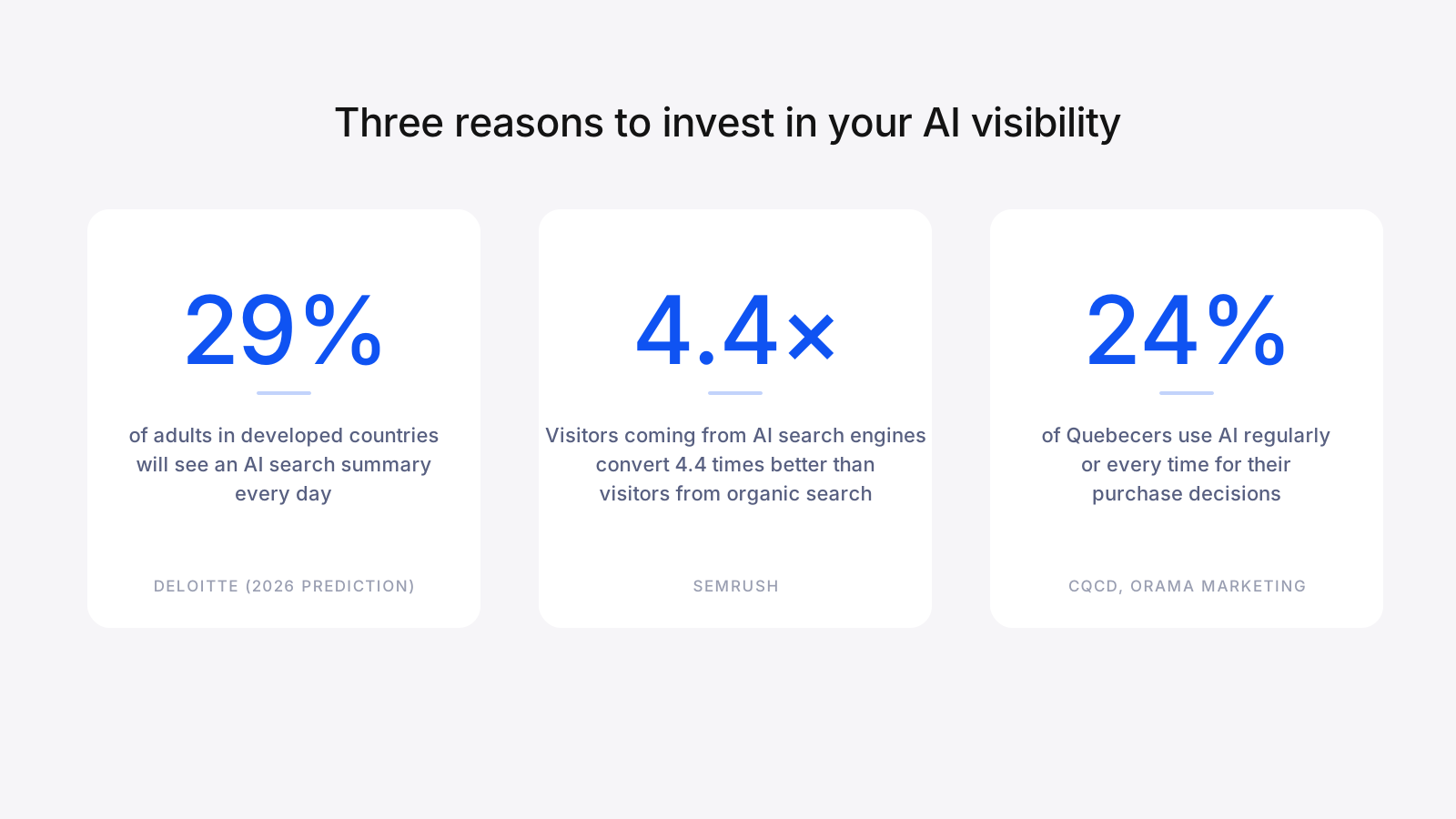
29% of adults in developed countries will see at least one AI-generated search summary every day, versus 10% who use a standalone AI app daily, according to Deloitte's 2026 predictions.
4.4 times: visitors arriving from an AI search engine convert 4.4 times better than organic search visitors, according to a Semrush study (June 2025) covering more than 500 digital marketing and SEO topics. They have already done much of their thinking in the conversation before they click.
1 Quebecer in 4 (24%) regularly or every time uses AI apps like ChatGPT, Claude or Gemini to support purchase decisions, according to the Conseil québécois du commerce de détail (CQCD) barometer, carried out with ORAMA Marketing.
Semrush also projects that, for topics related to digital marketing and SEO, AI search (ChatGPT and Google AI in particular) could drive more traffic than Google by 2028. It is a projection for a specific sector, not a general law, but the direction is clear: total traffic does not disappear, it moves.
Who uses AI to make a purchase decision in Quebec?
In Quebec, AI is used most to decide on a purchase by people aged 35 to 44 (30%), and fewer than 10% of people 55 and over use it. Here is the share of Quebecers who use it regularly or every time, by age group, according to the Conseil québécois du commerce de détail barometer.
| Age group | Uses AI to support purchases |
|---|---|
| 18-24 | 27% |
| 25-34 | 24% |
| 35-44 | 30% |
| 45-54 | 18% |
| 55-64 | 8% |
| 65 and over | 8% |
Source: Conseil québécois du commerce de détail barometer. Share of respondents who use AI "regularly" or "every time".
Plenty of potential, and we are only at the start
In Quebec, people aged 35 to 44 are the biggest users of AI for purchases (30%), which covers a good share of decision-makers and business-service buyers. Among people 55 and over, it is under 10%. The shift is not finished, which leaves a window to get ahead before your competitors move.
What are the key statistics on AI search and GEO?
The numbers that matter in GEO come down to nine sourced statistics: 29% of adults in developed countries will see an AI search summary every day (Deloitte), their visits convert 4.4 times better (Semrush), and adding statistics, quotations and sources can improve relative visibility in generated answers by 30 to 40% (GEO study by Princeton and IIT Delhi, 2024). Here is the full table, free to quote with its source.
| Statistic | Figure | Source |
|---|---|---|
| Adults in developed countries who will see an AI search summary every day (2026 prediction) | 29% | Deloitte (2026) |
| Conversion of AI-referred visitors compared with organic search | 4.4 times higher | Semrush |
| Quebecers who use AI regularly or every time for purchase decisions | 24% (about 1 in 4) | CQCD (ORAMA Marketing) |
| Quebecers aged 35 to 44 who use AI for purchases | 30% | Conseil québécois du commerce de détail |
| Relative visibility increase from adding statistics, quotations and sources | 30 to 40% | Semrush |
| Freshness of content cited by AIs, compared with Google | 25.7% more recent | Ahrefs (17 million citations, 2025) |
| Highly cited ChatGPT pages updated in 2025 | 89.7% | Ahrefs (564 pages) |
| Correlation between branded mentions and AI visibility | 0.664 | Ahrefs (about 75,000 brands) |
| Share of list pages in ChatGPT citations | 43.83% | Analysis of 750 queries |
Statistics presented in Oriana Solutions' GEO training. See the list of sources at the end of the article.
Original data: a GEO advantage
Add studies and statistics to your pages, and above all your own data. Original data is especially valuable for GEO: if you are the only source of a number, an AI has no choice but to cite you. Publish the result of a customer survey, averages drawn from your projects or audits (anonymized), real prices, or a comparative test. State the method, the date and the sample size, and update them every year.
How can you test in 2 minutes what AIs say about your business?
Ask these five questions to ChatGPT, Gemini and Perplexity, each in a new conversation, then note for each AI: are you cited? Who is cited instead of you? Which sources are shown? This test is your starting point, and you will repeat it every month in chapter 10.
- ✓"Which company should I choose for [your service] in [your city]?"
- ✓"Who are the best [your trade] in [your city] and why?"
- ✓"What do you know about [your business name]?"
- ✓"How much does [your service] cost in Quebec?"
- ✓"Is [your business name] reliable? What reviews exist?"
Is SEO dead because of AI?
No. An AI must first discover, access, understand and evaluate your content, and good SEO practices make each of those steps easier: SEO is the foundation of GEO, not its competitor. What changes is that ranking on Google is no longer enough: you also need to be cited in generated answers. So do not stop your SEO, complete it.
Key takeaways from chapter 1
- 1Search increasingly runs through AI (29% of adults in developed countries will see an AI search summary every day, according to Deloitte).
- 2Visitors from AI engines convert better, according to Semrush.
- 3In Quebec, adoption is already here (1 in 4) but far from finished, which leaves a window to get ahead.
Sources for this chapter
- 1.Deloitte, 2026 Technology, Media & Telecommunications Predictions — 29% of adults in developed countries will see at least one AI search summary daily, versus 10% using a standalone AI app (published November 18, 2025).
- 2.Conseil québécois du commerce de détail (CQCD) barometer with ORAMA Marketing — 24% of Quebecers use AI regularly or every time for purchase decisions, 47% never; 30% among 35 to 44 year-olds and 8% among people 55 and over (September 2026).
- 3.Semrush, AI search and traffic study — Visitors from AI search are worth 4.4 times more than organic search visitors; projection of AI traffic overtaking traditional search for digital marketing and SEO topics by 2028 (500+ topics analyzed).
Ask the five questions above to ChatGPT, Gemini and Perplexity. In a spreadsheet, note for each: are you cited (yes or no) and which competitors are named. Keep this table: it is your starting point. Want to repeat this test every month without thinking about it? GEO Monitor does it for you.