The first pillar of GEO is complete, sourced, up-to-date content, because an AI can only cite what exists. This chapter covers the basic rules, the most-cited formats and content freshness.
What you will learn
- Which topics and formats AIs cite most
- Why freshness and original data matter
- A checklist to apply before every publication
Lesson outline
- 1Pillar 1: how do you create relevant, credible content that AIs cite?
- 2Why do you need to cover a topic completely?
- 3Which type of page do AIs cite the most?
- 4How do you pick article topics for GEO?
- 5Why vary formats and platforms for GEO?
- 6Why is fresher content cited more by AIs?
- 7What does an article designed to be cited by an AI look like?
- 8How do you produce your own original data?
- 9Checklist before publishing content
- 10Hands-on exercise
- 11Key takeaways
Pillar 1: how do you create relevant, credible content that AIs cite?
To create content that AIs cite, publish pages that are complete, precise and backed by data: an AI can only cite what exists. This is the most underestimated pillar. Here are the basic rules:
- ✓Don't write articles nobody is searching for. Start from what your customers actually type or ask, not from what you feel like writing.
- ✓Have enough content: ideally at least 800 words for an article, to cover the topic in depth.
- ✓Optimize images, headings and subheadings for SEO: alt text, a logical heading hierarchy, headings that contain the topic.
- ✓Add studies and statistics: original data is excellent for GEO. According to the GEO study by Princeton and IIT Delhi (2024), adding statistics, quotations and sources can improve relative visibility in generated answers by 30 to 40%. Always cite the source, and publish your own numbers when you can.
- ✓Analyze your competitors and their articles with a paid SEO tool (about $150 a month) and run keyword research to find out what people really search for.
- ✓Check Google Search Console to see the queries that generate impressions and clicks to your site, then create content around those topics.
- ✓Create "how to" content on YouTube: video tutorials are a source AIs cite, and they strengthen your brand presence.
Why do you need to cover a topic completely?
You need to cover a topic completely because an AI does not run a single search: it often breaks the user's question into several sub-searches ("fan-out queries"), then keeps the pages that answer the most angles.
Take the example "How do I start a podcast?". A page that covers only the basics will lose to a competitor's page that also covers equipment, hosting and promotion.
| Topic covered | Your page | Competitor's page |
|---|---|---|
| The basics | ✓ | ✓ |
| Equipment | ✗ | ✓ |
| Hosting | ✗ | ✓ |
| Promotion | ✗ | ✓ |
For a given topic, compare your page with the ones already being cited and fill in the missing angles.
Which type of page do AIs cite the most?
An analysis of 750 top-of-funnel queries in ChatGPT shows that list pages dominate by far: "Best software for…", "Top 10" and comparison pages. Ordinary blog posts, landing pages and product pages come far behind.
| Page type | Software | Agencies | Products | Average |
|---|---|---|---|---|
| List (blog) | 51.39% | 40.64% | 39.47% | 43.83% |
| Blog post | 6.72% | 4.94% | 31.36% | 14.34% |
| Landing page | 14.60% | 16.99% | 0.09% | 10.56% |
| Product page | 0.84% | - | 19.14% | 9.99% |
| Non-blog list | 11.66% | 16.29% | 0.11% | 9.35% |
Most prominent page types in ChatGPT responses, across 750 top-of-funnel queries.
What this changes for you
Publish honest comparisons in your field: "Best X in 2026", "X vs Y", "How much does X cost". It is the format we chose ourselves for our guides Best website building platforms and Best vibe coding tools. A credible comparison states its criteria, prices and limits, including your own.
How do you pick article topics for GEO?
To pick the topics to write first, look for accessible opportunities: in the results of a search, aim for topics with strong traffic, a low DR and few backlinks, while staying relevant to your business.
DR (domain rating) measures the strength of a site's incoming links. If a page with a DR of 0 and no backlinks gets more than a thousand visits a month, the spot is winnable. Conversely, a topic dominated by DR 90 sites with hundreds of links will need a different strategy.
Why vary formats and platforms for GEO?
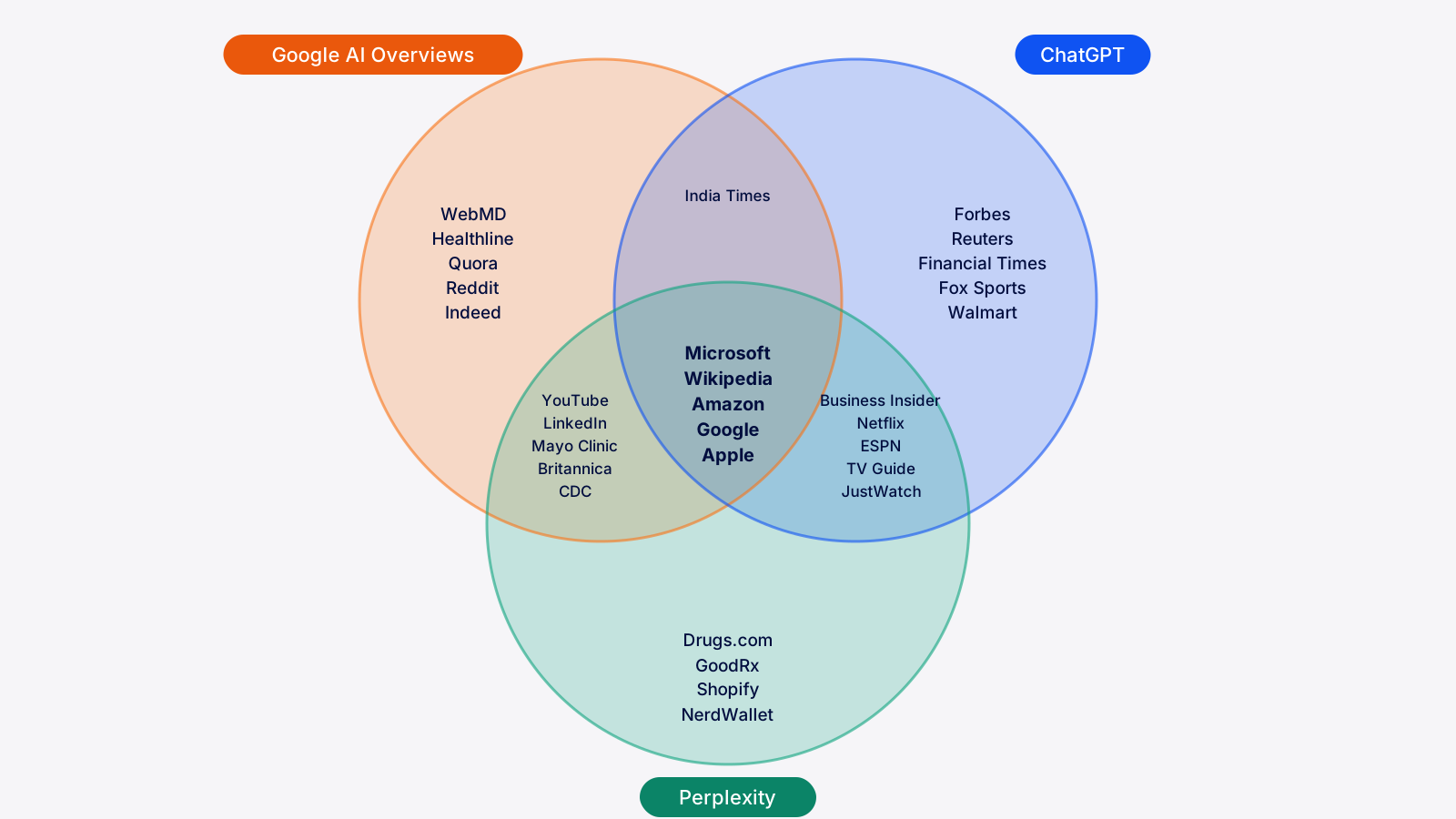
You should vary formats and platforms because AIs are not all trained or fed the same way: each engine relies on its own training data, its own index and its own sources. As a result, each has its favourites. When you compare the 50 most mentioned sites across Google's AI Overviews, ChatGPT and Perplexity, only 7 show up in all three, according to Ahrefs (June 2025). In the diagram below, the shared sites include Microsoft, Wikipedia, Amazon, Google and Apple. The rest is specific to each engine: WebMD and Reddit for Google, Forbes and Reuters for ChatGPT, NerdWallet and Shopify for Perplexity.
To raise your chances of being cited by several engines, vary your formats (articles, lists, videos, FAQs) and be present on several platforms (YouTube, LinkedIn, directories, media, forums).
Why is fresher content cited more by AIs?
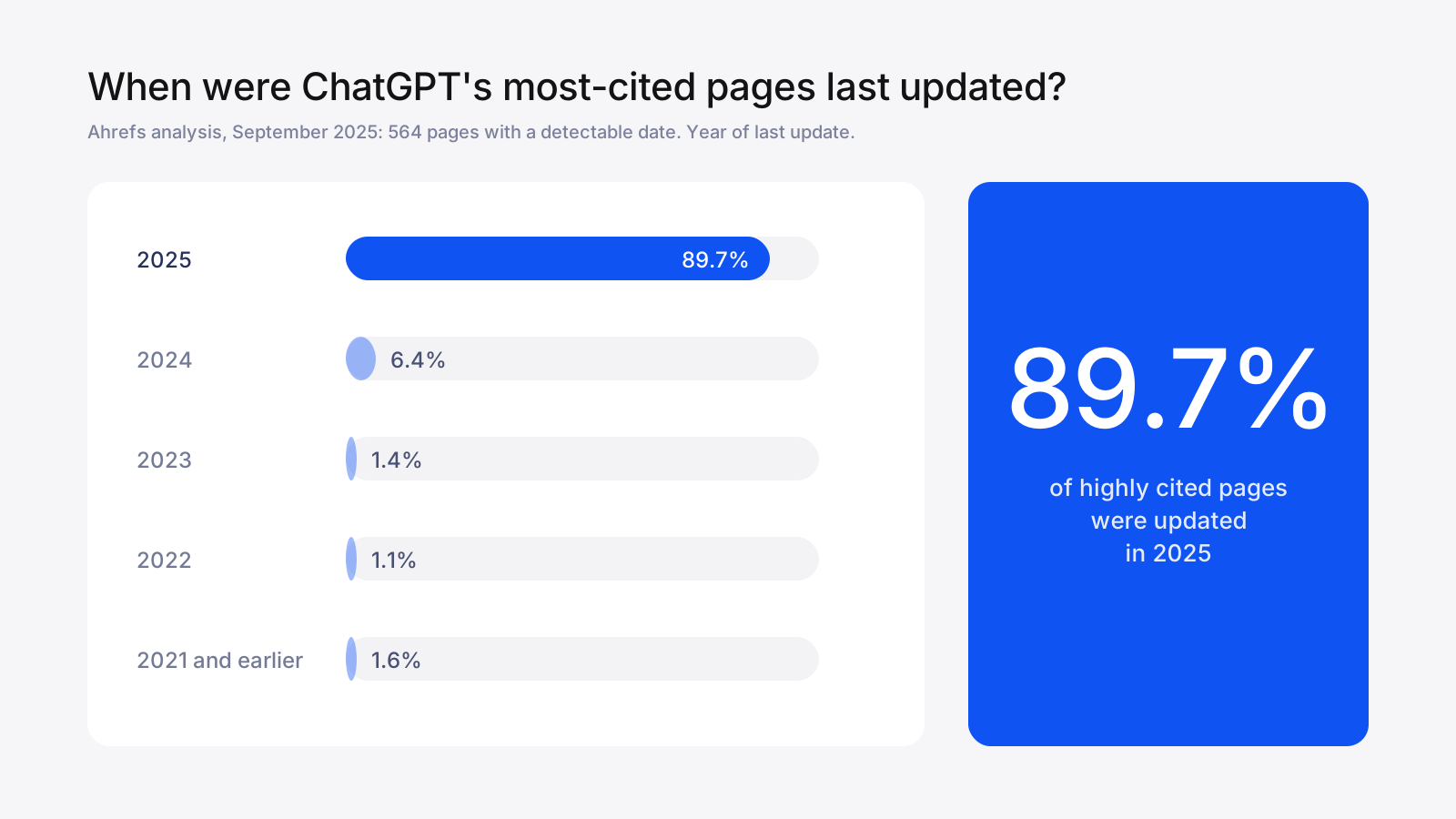
Because AIs favour recent information. According to an Ahrefs analysis of 17 million citations (2025), AIs cite content that is on average 25.7% more recent than what Google surfaces. In another Ahrefs analysis (September 2025), covering the 564 pages highly cited by ChatGPT whose update date could be detected, 89.7% had been updated in 2025, and 76.4% had been updated 1 to 6 months earlier.
In GEO, creating new content or regularly updating existing content therefore helps you stay relevant in AI-generated answers.
In practice
Schedule updates to your most important pages (figures, prices, examples, sources) at least once a quarter, and display the update date. Publishing a new article now and then is not enough: your strategic pages are the ones that must stay fresh.
What does an article designed to be cited by an AI look like?
A citable article answers first, proves second and can be split into standalone pieces. Here is the template we recommend (the 40 to 60 words is an Oriana recommendation, not an engine rule):
- ✓A question title, using your customers' words.
- ✓A direct answer of 40 to 60 words in the first lines.
- ✓Question subheadings, each with an answer that stands on its own.
- ✓A table or a list to compare or enumerate.
- ✓Sourced numbers, with the organization and year.
- ✓An FAQ at the end, marked up with Schema.org.
- ✓An identified author and a visible update date.
How do you produce your own original data?
Original data is especially good for GEO, because if you are the only source of a number, an AI has no choice but to cite you. Five simple ways to produce it:
- ✓A short survey of your customers or your list (even a few questions).
- ✓Averages from your projects, anonymized: timelines, budgets, results.
- ✓Real prices or ranges from your quotes.
- ✓A documented comparison test: tools, methods or products, with your criteria.
- ✓A LinkedIn poll whose results you publish with commentary.
Always state the method
Original data is only valuable if it can be judged: state the date, the sample size and how you collected the information. Never invent a number.
Checklist before publishing content
Reread this list before every publication: each box ticked raises your chances of being understood and cited.
- ✓The topic matches a real search (Search Console, keyword tool).
- ✓The content covers every angle of the topic (at least 800 words for an article).
- ✓Headings are questions and sentences are natural.
- ✓Numbers are sourced and up to date.
- ✓Images have a descriptive alt text.
- ✓Two or three internal links lead to related pages.
- ✓The FAQ and Schema.org markup are in place.
- ✓The update date is visible.
Key takeaways from chapter 4
- 1Answer first, prove second, with sources.
- 2Cover the topic completely and favour lists and comparisons.
- 3Keep content fresh and publish your own data when you can.
Sources for this chapter
- 1.Aggarwal et al., "GEO: Generative Engine Optimization" (Princeton, IIT Delhi, KDD 2024) — The three best methods (citations, expert quotations, statistics) improve relative visibility by 30 to 40%.
- 2.Ahrefs, "Do AI assistants prefer to cite fresh content?" — 17 million citations analyzed: cited content is 25.7% fresher than in Google's organic results.
- 3.Ahrefs, study of ChatGPT's most-cited pages (September 2025) — 564 pages with a detectable update date: 89.7% updated in 2025, 76.4% 1 to 6 months earlier.
- 4.Ahrefs, study of "best" lists and ChatGPT visibility — Analysis of 750 top-of-funnel prompts (software, products, agencies): the page types most present in answers.
- 5.Ahrefs, "86% of Top Mentioned Sources Are Not Shared Across ChatGPT, Perplexity, and AI Overviews" (Patrick Stox, June 12, 2025) — Among the 50 most mentioned sites for each engine (June 2025: about 76.7M AI Overviews queries, 957k for ChatGPT and 953.5k for Perplexity), only 7 appear across all three.
Pick your most important service page. Rewrite its introduction as a direct 40 to 60 word answer to "How do I choose [this service]?", then add one sourced number.