Choosing a software development company in Montreal is hard: prices are rarely published, directories contradict each other on team sizes and rankings are often written by the agencies themselves.
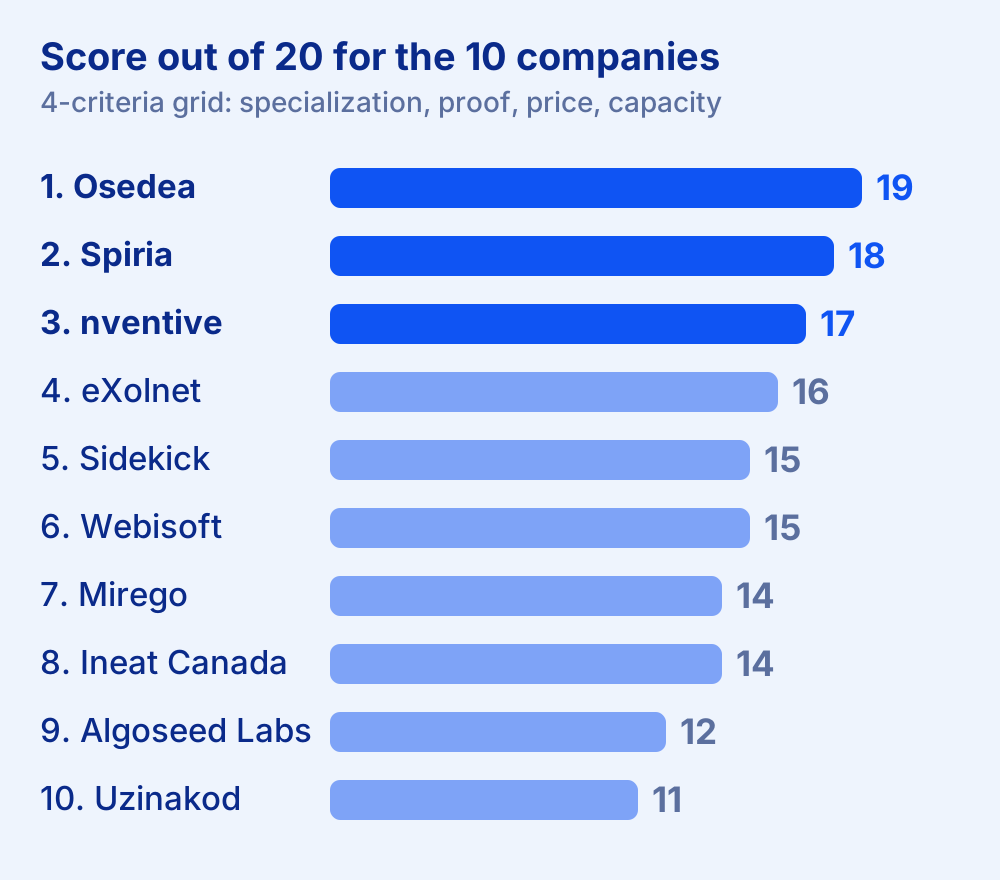
We compared ten Montreal custom software companies with the same grid: headcount, estimated price (published hourly rate and minimum project), clients, projects and specialty, then a score out of 20. This ranking is for SMEs, nonprofits and startups looking for a development partner in Montreal. The data comes from Clutch, public directories and the companies' websites (October 2026), and the score sums up four criteria explained below.
It covers custom software development only (web apps, platforms, SaaS, internal tools) and excludes agencies that only build brochure websites or do marketing.
Quick answer
According to our four-criteria grid out of 20, the three best custom software development companies in Montreal in 2026 are Osedea (19/20), Spiria (18/20) and nventive/Wepoint (17/20). They target projects of $50,000 and up. For a smaller budget, Webisoft and Algoseed Labs are the most accessible.
Summary: the answers in 30 seconds
- ✓Which is the best company? Osedea (19/20), followed by Spiria (18/20) and nventive/Wepoint (17/20).
- ✓How much does it cost? Published hourly rates range from $50 to $199/h. Minimum projects range from $1,000 to over $100,000, depending on the company.
- ✓Which has the biggest team? nventive/Wepoint (160 to 250+ people), followed by Spiria (~150) and Mirego (~140).
- ✓Which is the cheapest? Algoseed Labs ($1,000+ minimum project) and Webisoft ($5,000+).
- ✓Which publishes its prices the least? Mirego and Uzinakod: we found neither a rate nor a minimum project. Ineat only shows a rate, in a single directory.
- ✓How did we choose? Four criteria scored from 0 to 5: specialization, public proof, price transparency and capacity.
- ✓Is AI changing prices? It depends: some companies keep their prices and deliver more, others lower them. At Oriana, prices are often about five times lower.
- ✓Why a local company? Language, culture, local laws (Law 25), time zone and clear recourse.
- ✓What should you ask before signing? Code ownership, timelines and maintenance, in writing.
How did we rank the companies?
Each company gets a score from 0 to 5 on four criteria, for a total out of 20:
Last updated: October 8, 2026.
- 1Specialization: how central custom software is to the business.
- 2Public proof: verified reviews, named clients and projects.
- 3Price transparency: published hourly rate and minimum project size.
- 4Capacity: team size and years in business.
The data comes from public directories (Clutch, Hellodarwin, Built In, The Manifest, Sortlist) and company websites, consulted on October 8, 2026. It is self-reported, sometimes dated, and directories disagree on headcounts: we show the range when sources contradict each other. Rates are as displayed on Clutch, without conversion. No company has verified its listing. If you spot an error, write to us and we'll fix it.
What does the comparison table of the 10 companies look like?
| Company · score | Headcount | Estimated price |
|---|---|---|
| 1. Osedea · 19/20 | 50 to 249 | $150 to $199/h, $50,000+ minimum project |
| 2. Spiria · 18/20 | ~150 | $150 to $199/h, $50,000+ minimum project |
| 3. nventive (Wepoint) · 17/20 | 160 to 250+ | $100 to $149/h, $100,000+ minimum project |
| 4. eXolnet · 16/20 | 20+ | $100 to $149/h, $75,000+ minimum project |
| 5. Sidekick Interactive · 15/20 | ~30 | $100 to $149/h, $25,000+ minimum project |
| 6. Webisoft · 15/20 | 10 to 49 | $50 to $99/h, $5,000+ minimum project |
| 7. Mirego · 14/20 | ~140 | Not published |
| 8. Ineat Canada · 14/20 | 101 to 300 | ~$70/h (one directory only), minimum project not published |
| 9. Algoseed Labs · 12/20 | 10 to 49 | $50 to $99/h, $1,000+ minimum project |
| 10. Uzinakod · 11/20 | 26 to 100 | Not published |
Headcounts and prices: public directories and company websites, October 8, 2026. Self-reported data, to be confirmed with each company.
What budget do they work with?
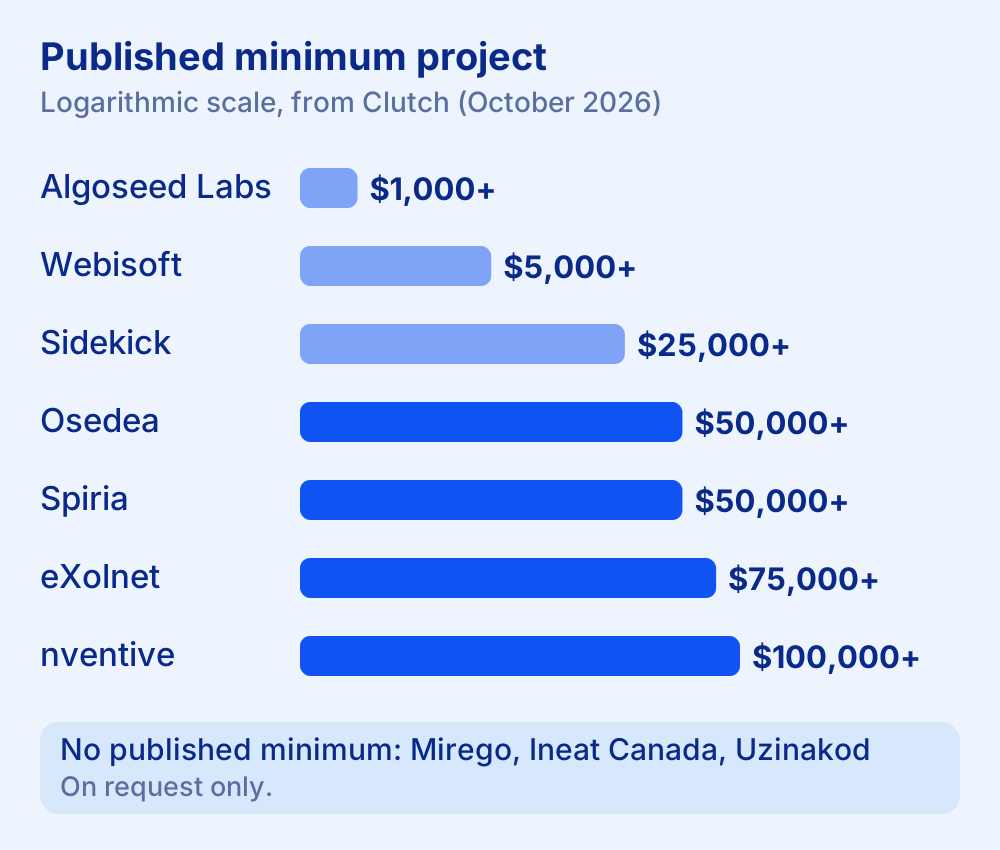
Hourly rates are hard to compare. The published minimum project gives a better sense of the entry budget.
| Project size | Companies whose published minimum falls there |
|---|---|
| Small project (under $25,000) | Algoseed Labs ($1,000+), Webisoft ($5,000+) |
| Mid-size project ($25,000 to $74,999) | Sidekick Interactive ($25,000+), Osedea ($50,000+), Spiria ($50,000+) |
| Large project ($75,000 and up) | eXolnet ($75,000+), nventive/Wepoint ($100,000+) |
| On request | Mirego, Ineat Canada, Uzinakod: no published minimum |
Minimums as displayed on Clutch in October 2026. These are not quotes: the final price depends on your project.
What drives the price of custom software
The number of features, integrations with other systems, payments, access management, compliance (Law 25, healthcare) and team seniority raise the bill more than the size of the company. See How much does custom software cost and our pricing.
Is AI lowering software development prices?
Yes, but it depends on the company. AI speeds up developers' work, and companies react in two ways.
Some keep exactly the same prices but deliver far more features than before the AI wave. Others lower their prices. At Oriana Solutions, the author of this article, our prices are often about five times lower than a traditional agency's, because we pass the savings from AI back to our clients.
To compare two companies, look at what you get for the same budget, not just the hourly rate:
- 1What has AI changed in your prices or timelines?
- 2How many features are included in this amount?
- 3Are the AI savings in the price, or only in the company's margin?
What are the 10 best companies, one by one?
Here is the detail of each company, in ranking order.
1. Osedea: AI, custom software, UX/UI, industrial (19/20)
Founded: 2011. Headcount: 50 to 249 according to Clutch.
Clients and projects: mostly industrial clients (manufacturing, health, mining, agri-food, finance). Projects published on Clutch include an AI vision system that detects packaging defects for a juice producer, a data platform for an AI solutions company and a web data-management platform for a real estate company.
Estimated price: $150 to $199/h, $50,000+ minimum project.
Reviews: 4.9 out of 5, about 44 reviews on Clutch.
Best for: a product where AI, vision or hardware plays a big role.
- ✓Strengths: Very strong reviews (4.9/5, about 44 reviews), expertise in AI, computer vision and hardware, a solid-sized team.
- ✓Limits: High entry ticket ($50,000+ minimum project, $150 to $199/h): not built for a small budget or a simple website.
- ✓Client types: Industrial, healthcare, mining, agri-food and financial companies, mid-sized to large.
Website: osedea.com
Score: 19/20 (specialization 5, proof 5, price 4, capacity 5).
2. Spiria: Enterprise software, application modernization (18/20)
Founded: 2003. Headcount: about 150 across Montreal, Gatineau and Toronto, according to its website.
Clients and projects: Aifred Health (healthcare), the Jacques Cartier and Champlain bridges (real-time security), Power Factors (energy management) and western Canadian dairy boards (supply chain), according to its directory profile.
Estimated price: $150 to $199/h, $50,000+ minimum project.
Reviews: 4.9 out of 5, 27 reviews on Clutch.
Best for: modernizing existing software or a critical system in a large organization.
- ✓Strengths: 20+ years in business, experience with critical systems, 4.9/5 reviews (27 reviews).
- ✓Limits: $50,000+ minimum project and $150 to $199/h: less suited to a quick MVP on a small budget.
- ✓Client types: Healthcare, energy, infrastructure and supply chain; mid-sized and large organizations.
Website: spiria.com
Score: 18/20 (specialization 5, proof 4, price 4, capacity 5).
3. nventive (Wepoint): Web and mobile apps for large enterprises (17/20)
Founded: 2008. Headcount: about 160 in Montreal and Quebec City per one directory, 250 to 999 per Clutch since joining the Onepoint group as Wepoint. Sources disagree.
Clients and projects: 60% large enterprises ($1B+ revenue) and 40% mid-market per Clutch, mostly in financial services, healthcare and logistics. The company says it has delivered more than 1,000 web and mobile apps. The Clutch reviews we found date mostly from 2016 to 2018.
Estimated price: $100 to $149/h, $100,000+ minimum project.
Best for: a large enterprise that wants a big team on a large project.
- ✓Strengths: Large team, long experience with big companies, more than 1,000 apps claimed.
- ✓Limits: $100,000+ minimum project, reviews we found are mostly old (2016 to 2018), uncertain headcount since joining the Onepoint group.
- ✓Client types: Mostly large enterprises (60%) and mid-sized companies (40%), in financial services, healthcare and logistics.
Website: nventive.com
Score: 17/20 (specialization 5, proof 3, price 4, capacity 5).
4. eXolnet: Custom web apps, modernization, AI (16/20)
Founded: 2007. Headcount: 10 to 49 per Clutch, "20+ specialists" per its own text.
Clients and projects: 90% mid-market companies per Clutch, mostly healthcare (40%), manufacturing (30%) and financial services (20%). The company says it has built more than 250 custom web apps over 15+ years, with a fully Canadian team and no outsourcing.
Estimated price: $100 to $149/h, $75,000+ minimum project.
Reviews: we couldn't find a verified review count.
Best for: an SME or mid-sized company that wants complex web software and a stable team.
- ✓Strengths: 100% Canadian team with no subcontracting, 250+ custom web apps in over 15 years, modernization specialty.
- ✓Limits: $75,000+ minimum project, few verified reviews found, a team of about 20 so limited capacity.
- ✓Client types: Mostly mid-sized companies (90%), in healthcare, manufacturing and finance.
Website: exolnet.com
Score: 16/20 (specialization 5, proof 3, price 4, capacity 4).
5. Sidekick Interactive: Mobile and web apps, healthcare (15/20)
Headcount: about 30 (11 to 50 per LinkedIn).
Clients and projects: City of Montréal, CIUSSS de l'Est-de-Montréal, Ville de Terrebonne, Flo (EV charging) and Leya (legal services), according to directories. Healthcare is its main sector.
Estimated price: $100 to $149/h, $25,000+ minimum project.
Reviews: 4.9 out of 5, 30 reviews on Clutch.
Best for: a native mobile app (iOS and Android) or a healthcare project.
- ✓Strengths: 4.9/5 reviews (30 reviews), native iOS and Android, experience in healthcare and with public clients.
- ✓Limits: Mobile-focused, so less suited to heavy enterprise software; a team of about 30; $25,000+ minimum project.
- ✓Client types: Mid-sized companies (70% according to one profile), public bodies and healthcare.
Website: sidekickinteractive.com
Score: 15/20 (specialization 4, proof 4, price 4, capacity 3).
6. Webisoft: Custom software, SaaS, blockchain (15/20)
Founded: 2016, with a second office in Miami. Headcount: 10 to 49 per Clutch (30 to 37 per other directories).
Clients and projects: web apps and SaaS platforms, including work for Edigo, Bull.Club and Dominion Finance per Sortlist, and Cogeco per The Manifest. Its distinctive specialty: blockchain and SaaS applications.
Estimated price: $50 to $99/h, $5,000+ minimum project.
Reviews: 4.9 out of 5, 23 reviews on Clutch.
Best for: a startup that wants an MVP or a SaaS at a lower entry budget.
- ✓Strengths: Low entry ticket ($5,000+, $50 to $99/h), 4.9/5 reviews (23 reviews), SaaS and blockchain experience.
- ✓Limits: A team of 10 to 49, named clients come mostly from directories, blockchain isn't relevant to every project.
- ✓Client types: Startups, SMEs and financial platforms.
Website: webisoft.com
Score: 15/20 (specialization 4, proof 4, price 4, capacity 3).
7. Mirego: End-to-end digital products, sports and media (14/20)
Headcount: about 140 in Montreal and Quebec City, according to Built In.
Clients and projects: apps for the CFL, the Montreal Canadiens, TSN and Bell, the official Canadian Grand Prix Formula 1 app and the digital platform behind TOMA for Premier Tech.
Estimated price: not published. We found neither an hourly rate nor a minimum project size.
Best for: a large consumer digital product in sports or media.
- ✓Strengths: About 140 people, large-scale consumer apps (CFL, Canadiens, TSN, Bell, Canadian Grand Prix).
- ✓Limits: Prices not published, no verified reviews found, geared toward large consumer products.
- ✓Client types: Sports leagues, media, telecoms and industrial companies (Premier Tech).
Website: mirego.com
Score: 14/20 (specialization 4, proof 4, price 1, capacity 5).
8. Ineat Canada: Digital transformation, custom solutions (14/20)
Headcount: 101 to 300 according to Hellodarwin. Canadian subsidiary of a French digital transformation group, based in Montreal.
Clients and projects: Ski Québec Alpin, Vidéotron and VIA Rail, according to its directory profile, with 41 projects completed. We found no verified reviews.
Estimated price: about $70/h according to a single directory. No minimum project published.
Best for: a large organization that wants a digital transformation team for custom projects.
- ✓Strengths: Large team (101 to 300 people), experience with major accounts like Vidéotron and VIA Rail.
- ✓Limits: Brand now tied to Astek, little public data, no verified reviews found, price from a single directory.
- ✓Client types: Major accounts and startups.
Website: astek.ca (Ineat's site now redirects to Astek: check the company's current name before contacting it)
Score: 14/20 (specialization 4, proof 3, price 2, capacity 5).
9. Algoseed Labs: Web and mobile apps for startups and SMEs (12/20)
Founded: 2020, in Verdun. Headcount: 10 to 49 per Clutch.
Clients and projects: a live chat platform built from scratch, a custom WordPress plugin for a Toronto video production studio and a mobile app for a nonprofit, according to Clutch reviews.
Estimated price: $50 to $99/h, $1,000+ minimum project.
Best for: a small web or mobile project on a limited budget.
- ✓Strengths: Accessible small budget ($1,000+, $50 to $99/h), comfortable with MVPs and WordPress plugins.
- ✓Limits: Young company (2020), small team, rates vary widely by directory ($30 to $99/h), more web and mobile than complex enterprise software.
- ✓Client types: Startups, small businesses, nonprofits and agencies.
Website: algoseedlabs.com
Score: 12/20 (specialization 3, proof 3, price 4, capacity 2).
10. Uzinakod: Systems integration, cloud, applications (11/20)
Founded: 2015. Headcount: 26 to 100 depending on the source.
Clients and projects: energy, healthcare, insurance, banking and finance. Microsoft and Databricks partner. We found no verified reviews or named projects.
Estimated price: not published.
Best for: systems integration, cloud and automation in regulated industries.
- ✓Strengths: About 10 years in business, Microsoft and Databricks partner, experience in regulated industries.
- ✓Limits: No price, review or named project found, uncertain headcount (26 to 100 people).
- ✓Client types: Energy, healthcare, insurance, banking and finance.
Website: uzinakod.com
Score: 11/20 (specialization 4, proof 2, price 1, capacity 4).
Bonus: three more Montreal companies to watch
Three other names deserve a comparison call. We didn't score them out of 20: for Thirdbridge and Witify, public data is too thin to apply the same grid, and Oriana Solutions is the author of this article.
Thirdbridge (thirdbridge.ca): founded in 2012, 26 to 50 people according to Hellodarwin (68 employees according to Built In). It builds mobile, web and desktop apps (React, React Native, Node.js, Swift, Kotlin) and UX/UI design. We found no rate, minimum project, review or named client.
Witify (witify.io): founded in 2016, 2 to 25 people depending on the source. It builds management and enterprise software (ERP, CRM, intranet), automation, web portals and AI analytics for SMEs, institutions and startups. It shows partners such as Desjardins and HEC Montréal on its site, which doesn't confirm a contract on its own. Hellodarwin lists a single review, rated 5 out of 5. No published prices.
Oriana Solutions (orianasolutions.ca): the author of this article, so outside the ranking. Three co-founders, no subcontracting, 5 years of experience. We built Quietnest (a mobile app ranked first in Canada at the Ose Entreprendre competition, used in more than 22 countries) and Consorm (our Law 25 consent-management SaaS), and we work with SMEs such as Le Balthazar, Pascan Aviation and Éval+. Our prices are public: custom website from $1,500 in 7 days, first web app from $5,000 in 14 days.
Why choose a local company over India, Fiverr or Upwork?
Because custom software is first a matter of understanding. Someone who knows your reality asks the right questions before writing a line of code. Here is what a local company brings:
- ✓Your language and culture: Quebec French, tone, humour, how to address your customers formally or informally. Machine-translated text stands out right away.
- ✓Local rules: Law 25 on personal information protection, the Charter of the French Language requirements, GST and QST, data hosted in Canada.
- ✓Local tools: payments in Canadian dollars, Interac, integrations with Quebec suppliers.
- ✓The time zone: same-day calls, in-person demos, a quick answer when something breaks.
- ✓Clear recourse: a contract under local laws and a registered company you can reach.
- ✓Your industry's issues: a local developer has already seen cases like yours (professional orders, CNESST, associations, local shops).
That doesn't mean every foreign freelancer is a bad choice. For a small, well-defined task (a logo, a script), a platform like Fiverr or Upwork can be enough. For software that touches your customers, your data and your operations, proximity makes the difference.
Timelines, maintenance and code ownership: what should you ask a company?
These three points are rarely published on companies' websites, and we found no clear public policy for most of those in the ranking. Ask for them in writing before signing:
- ✓Code ownership: the source code should belong to you. Ask that the work be done in your code repository and on your hosting accounts, in your name.
- ✓Timelines: a staged schedule with demos, and what happens if a deadline slips. A timeline is a ballpark unless it's in the contract.
- ✓Maintenance: who fixes bugs after delivery, for how long at no charge, and how much an ongoing plan costs.
- ✓Handover: documentation, server access and a transition if you change partners.
As an example, at Oriana Solutions the code is 100% yours from day one, a website can be delivered in 7 days and a first app in 14 days (ballparks, not contractual guarantees), and bugs are fixed at no charge within 30 days of delivery.
What if you arrive with an app already built with Claude, Replit, Lovable or Base44?
This is a new reality for agencies. Managers, employees and entrepreneurs who would never have coded start building apps by chatting with an AI, with tools like Claude, Replit, Lovable or Base44. It's called "vibe coding". The result is often impressive: a prototype that shows exactly what the person wants.
At Oriana, it helps us understand the client's vision: we see the idea, not just a description. And many come to us because they've hit a ceiling. They now need to:
- ✓integrate payments;
- ✓secure the database;
- ✓add reliable authentication;
- ✓plug in a real back end.
Nothing works as planned, so they come to us to reach the next level. If that's your case, ask the company whether it can take over an existing prototype rather than redo everything, and what it would keep or rewrite.
Why doesn't AI eliminate the need for developers? The Jevons paradox
In 1865, British economist William Stanley Jevons observed that more efficient steam engines hadn't reduced coal consumption in the United Kingdom: they had increased it. When a resource becomes cheaper to use, people find more uses for it, and total demand rises. That's the Jevons paradox.
Applied to software: if AI makes building software far cheaper, we won't build the same amount of software for less, we'll build far more of it, in places where it was never profitable before. Projects that wouldn't have existed at $50,000 exist at $5,000, and their creators end up needing developers to take them further.
Where is software development heading by 2035?
Here is our vision. These are hypotheses, not certainties.
- ✓Systems that talk to each other: more and more software will communicate through autonomous agents that carry out tasks themselves: sending an invoice, following up with a customer, updating inventory.
- ✓Software that evolves in real time: before, you had to pick a report from a list. Tomorrow, you'll describe what you want by chatting with a built-in AI, and it will produce the custom report. The software could also gain new features without waiting for an update.
- ✓More custom software: why pay thousands of dollars to Pipedrive, Monday or Salesforce when you can have your own application, built for the way you work? (see our CRM comparison)
- ✓A huge gap between what businesses do with AI and what they could do: many will need an AI advisor or broker to find the right solutions and automate their processes.
- ✓Results instead of hours: we'll stop selling hours and sell products, automations and results. The client will pay to solve a business problem, for example a solution that cuts 15 hours of administrative work for their team.
Which company should you choose for your need?
- ✓Industrial or AI project, budget of $50,000 and up: Osedea.
- ✓Modernizing an existing system: Spiria.
- ✓Large enterprise, big team: nventive/Wepoint or Ineat Canada.
- ✓Native mobile app or healthcare project: Sidekick Interactive.
- ✓MVP or SaaS at a lower entry budget: Webisoft or Algoseed Labs.
- ✓Consumer product in sports or media: Mirego.
What should you ask before signing?
Whatever you choose, ask for these five things in writing: a fixed price or range, references from clients your size, ownership of the source code, who actually works on your project (employees or subcontractors) and the post-delivery support plan. Our guide How to choose a custom software developer covers these points, and How much does custom software cost explains what drives the price.
Want a ballpark for your project?
Our calculator gives you a free estimate in a few clicks, based on our delivered projects.
Go further
What is the best custom software development company in Montreal?
According to our four-criteria grid out of 20 (specialization, public proof, price transparency and capacity), Osedea comes first with 19/20, followed by Spiria (18/20) and nventive/Wepoint (17/20). The best choice depends on your budget, project size and industry.
How much does custom software cost in Montreal?
Hourly rates displayed by Montreal companies range from $50 to $199/h. Minimum projects range from $1,000 for small teams to over $100,000 for large firms. A first web app can start around $5,000 at the smallest companies.
What's the difference between a large and a small software company?
Large firms (50 to 250 people) offer more capacity, full teams and proven processes, but generally require projects of $50,000 and up. Small teams (3 to 50 people) are more affordable and more direct, with less capacity for very large projects.
How do you compare two software development companies?
Compare real headcount, rate or minimum project, clients of a similar size, projects delivered in your industry and specialty. Ask for references and check reviews on Clutch or Google.
Why isn't Oriana Solutions in the ranking?
Because Oriana is the author of the article, and an agency shouldn't rank itself. We are a small team of three co-founders, and the ranking compares established firms of 20 to over 100 people. We cover ourselves in the bonus section, alongside Thirdbridge and Witify.
Does AI lower the price of custom software?
It depends on the company. Some keep their prices but deliver far more features than before AI, others lower their rates. Oriana Solutions, the author of this article, passes the AI savings back to clients, with prices often about five times lower than a traditional agency's.
Why choose a local company over Fiverr, Upwork or India?
For an understanding of your language, your culture and local rules (Law 25, Charter of the French Language, taxes), for the time zone and for clear recourse if something goes wrong. For a small, isolated task, a platform can be enough.
Who owns the code of custom software?
It must be written in your contract. Ask that the code be yours, that the work be done in your code repository and on your hosting accounts, and that documentation and access be handed over at delivery.
Can a company take over an app built with Lovable, Replit, Base44 or Claude?
Yes, it's increasingly common. The prototype shows the vision well, but it often lacks payments, a secure database, authentication and a real back end. Ask the company what it keeps from the prototype and what it rewrites.
What is the Jevons paradox?
In 1865, William Stanley Jevons observed that more efficient steam engines increased coal consumption instead of reducing it. Applied to AI: software that is cheaper to create leads to far more of it being created.
What will software development look like in 2035?
In our view: software that communicates through autonomous agents, evolves in real time thanks to a built-in AI, more custom software replacing subscriptions, and agencies selling results rather than hours.
- 1.Clutch — Top Software Developers in Montreal (October 2026)
- 2.Clutch — eXolnet profile
- 3.Clutch — nventive x Wepoint profile
- 4.Spiria — About Spiria
- 5.Hellodarwin — Osedea, Ineat Canada, Algoseed Labs and Uzinakod profiles
- 6.Built In — Mirego and Sidekick Interactive profiles
- 7.The Manifest — Web Development Companies in Montreal